N5 Review & Capstone
Learning objectives
- Review core N5 particles and their interactions in complex sentences.
- Consolidate verb and adjective conjugations (Present, Past, Negative, て-form).
- Synthesize counting, comparison, and expressions of desire.
- Master the cultural nuances of Omotenashi in daily Japanese life.
Congratulations! You have reached the final milestone of the N5 curriculum. You have transformed from someone who only knew “Konnichiwa” into a student who can describe their day, count objects and people, express complex desires, compare alternatives, and link multiple actions together.
This chapter is a Synthesis. We won’t introduce new rules; instead, we will see how all the pieces of the puzzle fit together in real-world scenarios. Take a deep breath—you are ready for the N5 Capstone!
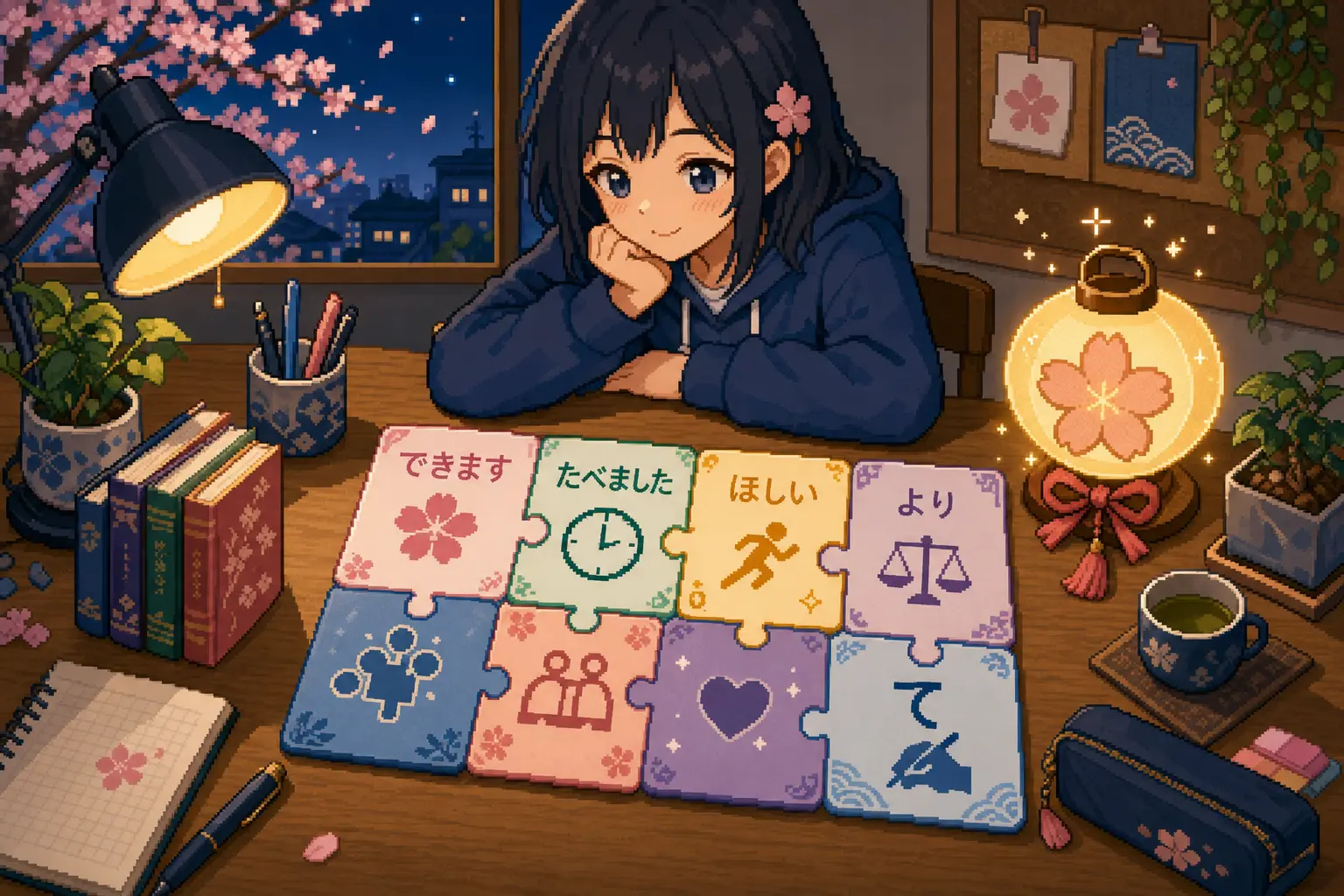
1. The Particle & Tense Engine
The foundation of your Japanese is built on how you link nouns to actions across time.
means Linking who, what, where, and when across time.
Formation
[Topic] は [Time] に [Location] で [Object] を [Verb (Tense)]
きのう は しちじ に ともだち と レストラン で すし を たべました。
Kinou wa shichi-ji ni tomodachi to resutoran de sushi o tabemashita.
Yesterday at 7:00, I ate sushi at a restaurant with a friend.
あした は どこ へ も いきません。いえ で べんきょうしたい です。
Ashita wa doko e mo ikimasen. Ie de benkyou shitai desu.
Tomorrow I'm not going anywhere. I want to study at home.
にほんご は むずかしい です が、とても おもしろい です。
Nihongo wa muzukashii desu ga, totemo omoshiroi desu.
Japanese is difficult, but it's very interesting.
せんしゅう は とても いそがしかった です。
Senshuu wa totemo isogashikatta desu.
Last week was very busy.
コーヒー を のんで、ほん を よみました。
Koohii o nonde, hon o yomimashita.
I drank coffee and read a book.
この かばん は あの かばん より やすい です。
Kono kaban wa ano kaban yori yasui desu.
This bag is cheaper than that bag.
2. Counting & Desire Review
Expressing what you want and how many you need is the key to surviving in Japan.
ほしい
Adjhoshii
Want (object)
〜たい
Suffix-tai
Want to (action)
ひとり / ふたり
Counterhitori / futari
1 / 2 people
ひとつ / ふたつ
Counterhitotsu / futatsu
1 / 2 items
おちゃ を ふたつ ください。
Ocha o futatsu kudasai.
Two green teas, please.
あたらしい くるま が ほしい です。
Atarashii kuruma ga hoshii desu.
I want a new car.
さんにん で にほん へ いきたい です。
San-nin de Nihon e ikitai desu.
I want to go to Japan with three people.
3. Cultural Note: Omotenashi in Daily Life
Throughout this book, we have mentioned Omotenashi (selfless hospitality). As you finish N5, it’s important to see how this affects your language choices:
- Politeness as Care: Using
〜ますand〜ですisn’t just about rules; it’s about making the listener feel comfortable (Anshin). - Indirectness: Instead of saying “I don’t like it,” a Japanese person might say “Chotto…” (It’s a bit…). This “space” (Ma) prevents conflict.
- Anticipation: A good host anticipates that you might want more water (Omizu ga hoshii) before you even ask for it (Kudasai).
Your ability to use Japanese correctly shows your respect for these cultural values. Speaking N5 Japanese is your entry ticket into this world of mutual respect and harmony.
Conversation Practice: The Final Challenge
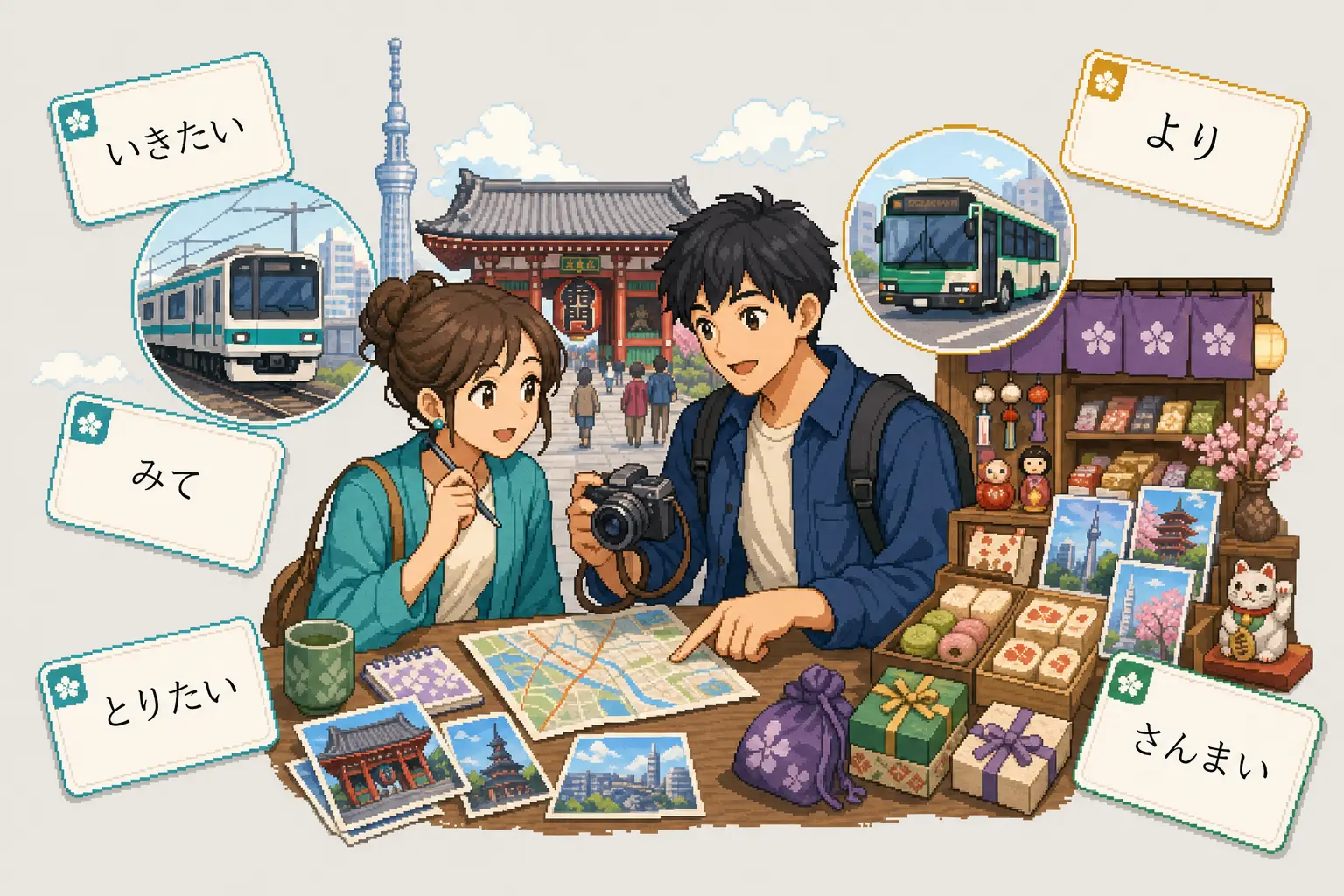
Dialogue 1: A Day in Tokyo (Roleplay)
たなかさん、あした は ひま です か。
Tanaka-san, ashita wa hima desu ka?
Mr. Tanaka, are you free tomorrow?
はい、ひま です よ。どこか へ いきたい です か。
Hai, hima desu yo. Dokoka e ikitai desu ka?
Yes, I am. Do you want to go somewhere?
あさくさ へ いきたい です。ふるい おてら を みて、しゃしん を とりたい です。
Asakusa e ikitai desu. Furui otera o mite, shashin o toritai desu.
I want to go to Asakusa. I want to see old temples and take photos.
いい です ね。あさくさ は とても きれい です よ。なに で いきます か。
Ii desu ne. Asakusa wa totemo kirei desu yo. Nani de ikimasu ka?
That's nice. Asakusa is very beautiful. How shall we go?
でんしゃ で いきましょう。バス より はやい です から。
Densha de ikimashou. Basu yori hayai desu kara.
Let's go by train. Because it's faster than the bus.
Dialogue 2: At the Gift Shop
すみません、この おかし を ごこ ください。
Sumimasen, kono okashi o goko kudasai.
Excuse me, five of these sweets, please.
はい。ひとつ 500えん です。ほか に なに か あります か。
Hai. Hitotsu gohyaku-en desu. Hoka ni nani ka arimasu ka?
Yes. They are 500 yen each. Is there anything else?
この ポストカード を さんまい おねがいします。あと、ちいさい はこ が ほしい です。
Kono posutokaado o sanmai onegaishimasu. Ato, chiisai hako ga hoshii desu.
Three of these postcards, please. Also, I want a small box.
わかりました。ぜんぶ で 2000えん です。
Wakarimashita. Zenbu de nisen-en desu.
Understood. That will be 2,000 yen in total.
はい。きのう も ここ で かいました。とても いい みせ です ね。
Hai. Kinou mo koko de kaimashita. Totemo ii mise desu ne.
Yes. I bought here yesterday too. It's a very good shop, isn't it?
Chapter Summary
- 1N5 grammar relies on the SOV structure and correct particle usage (wa, ga, o, ni, de, e).
- 2Tense is expressed through verb endings (mashita) and adjective endings (katta/deshita).
- 3Counters must match the object type (tsu, ko, mai, nin, jikan).
- 4Comparison uses 'A wa B yori' and 'A no hou ga'.
- 5Desire is expressed with 'hoshii' (nouns) and '-tai' (actions).
- 6The て-form is the essential 'glue' for linking sequential actions.
- 7Omotenashi is the spirit of hospitality that guides Japanese social interaction.
N5 Mega-Quiz: Final Assessment
Test your comprehensive N5 knowledge!
Which particle marks the direct object of a verb?
Practice Quiz
Which particle marks the direct object of a verb?
- は
- が
- を
- に
What is the past tense of 'おいしい' (delicious)?
- おいしい でした
- おいしかった
- おいしい かった
- おいしく でした
How do you conjugate 'のむ' (to drink) into 'want to drink'?
- のむたい
- のみたい
- のまたい
- のもたい
Translate: 'I ate with two people.'
- ふたり と たべました。
- ふたり で たべました。
- ににん と たべました。
- ふたつ と たべました。
Which particle means 'because' at the end of a sentence?
- から
- まで
- より
- ので
What is the te-form of 'いく' (to go)?
- いいて
- いって
- いきて
- いんで
Translate: 'Which is bigger: Japan or Brazil?'
- にほん と ブラジル と どちら が おおきい です か。
- にほん は ブラジル より おおきい です。
- ブラジル の ほう が おおきい です。
- にほん が いちばん おおきい です。
How do you say 'It was not cold'?
- さむくない でした
- さむくなかった です
- さむい じゃありませんでした
- さむい くなかった
Which counter is used for flat objects like shirts or paper?
- 〜つ
- 〜個
- 〜枚
- 〜人
Translate: 'I wake up, drink coffee, and go to school.'
- おきて、コーヒー を のんで、がっこう へ いきます。
- おきます、コーヒー を のみます、がっこう へ いきます。
- おきて、コーヒー を のむ、がっこう へ いく。
- おきて、コーヒー を のんで、がっこう へ いきたい。
What is the polite negative of 'くる' (to come)?
- きません
- こません
- くません
- きない
Which word means 'the most'?
- とても
- いちばん
- ちょっと
- あまり
Translate: 'I want money.'
- おかね が ほしい です。
- おかね を ほしい です。
- おかね が ほしいたい です。
- おかね を ほしいたい です。
What does 'Omotenashi' emphasize?
- Speed
- Selfless hospitality
- Lowest price
- Modern technology
How many is 'みっつ'?
- 1
- 2
- 3
- 4
Applied review
Use what you learned
Focus: N5 synthesis. Try the task before revealing the model.
Produce the Japanese sentence, then compare it with the model answer.
1.Describe yesterday using a time, place, object, and past verb.
N5 synthesis in context
N5 mini-reading
- Why did they stay and talk?