Counters Part 2: People & Time
Learning objectives
- Count people correctly using 〜人 (nin) and the irregulars (hitori, futari).
- Express time durations using 〜時間 (jikan), 〜日 (nichi), and 〜ヶ月 (kagetsu).
- Compare two or more items using より (than) and ほう (more).
- State the 'best' or 'most' using いちばん (ichiban).
- Understand the etiquette of gift-giving and the significance of numbers.
Now that you can count objects, it’s time to count the most important things of all: people and time! Whether you are making a reservation for three or describing a vacation that lasted five days, these counters are essential for daily life.
Furthermore, we will learn how to compare these things. “Which is faster?” “Who is taller?” “What is the best food in Japan?” By the end of this chapter, you’ll be able to express preferences and make informed choices.
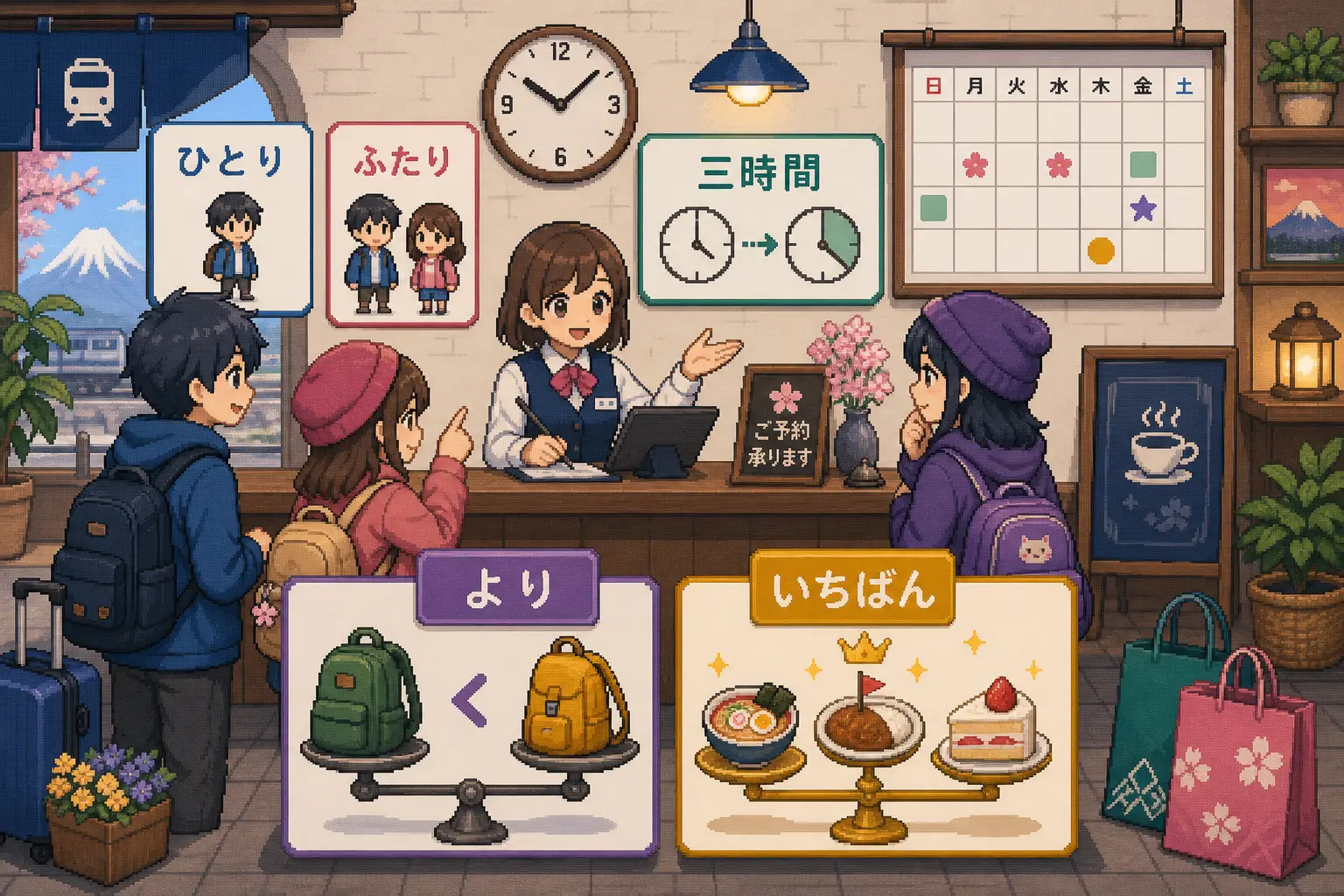
1. Counting People: 〜人 (nin)
Counting people uses the suffix 〜人 (nin). However, the first two are famously irregular and must be memorized separately.
ひとり
Counterひとり
hitori
1 person (IRREGULAR)
ふたり
Counterふたり
futari
2 people (IRREGULAR)
さんにん
Counterさんにん
san-nin
3 people
よにん
Counterよにん
yo-nin
4 people (IRREGULAR)
ごにん
Counterごにん
go-nin
5 people
かぞく は よにん です。
Kazoku wa yo-nin desu.
There are four people in my family.
ひとりで びじゅつかん へ いきました。
Hitori de bijutsukan e ikimashita.
I went to the art museum alone (by 1 person).
あそこ に おんなのひと が さんにん います。
Asoko ni onnanohito ga san-nin imasu.
There are three women over there.
2. Counting Time Durations
To express how long something lasts (rather than the time on a clock), we use different suffixes.
- 〜時間 (jikan): Hours (e.g., san-jikan = 3 hours).
- 〜日 (nichi / -ka): Days (e.g., futsuka = 2 days). Note: 〜かん (kan) is an optional suffix that emphasizes a span, e.g. futsuka-kan.
- 〜週間 (shuukan): Weeks.
- 〜ヶ月 (kagetsu): Months.
means Expressing duration.
Formation
Number + Time Counter
まいにち はちじかん ねます。
Mainichi hachi-jikan nemasu.
I sleep for eight hours every day.
にほん に いっしゅうかん います。
Nihon ni isshuukan imasu.
I will be in Japan for one week.
にかげつ べんきょうしました。
Ni-kagetsu benkyoushimashita.
I studied for two months.
ここ から えき まで じゅっぷん かかります。
Koko kara eki made juppun kakarimasu.
It takes ten minutes from here to the station.
さんじかん えいが を みました。
San-jikan eiga o mimashita.
I watched a movie for three hours.
なつやすみ は にしゅうかん でした。
Natsuyasumi wa ni-shuukan deshita.
The summer vacation was two weeks long.
3. Comparison: より, ほう, and いちばん
Japanese adjectives don’t have “-er” or “-est” forms. Instead, we use particles and adverbs to show comparison.
- A は B より [Adj] です: A is more [Adj] than B.
- A と B と どちら が [Adj] ですか: Between A and B, which is more [Adj]?
- A の ほう が [Adj] です: A is the one that is more [Adj].
- [Group] で [Noun] が いちばん [Adj] です: Within [Group], [Noun] is the most [Adj].
means Choosing the better or best alternative.
Formation
[A] wa [B] yori... / [Winner] no hou ga...
でんしゃ は バス より はやい です。
Densha wa basu yori hayai desu.
The train is faster than the bus.
ねこ の ほう が すき です。
Neko no hou ga suki desu.
I like cats more (the cat side is liked).
にほんご で かんじ が いちばん むずかしい です。
Nihongo de kanji ga ichiban muzukashii desu.
In Japanese, kanji is the most difficult.
コーヒー と おちゃ と どちら が すき です か。
Koohii to ocha to dochira ga suki desu ka?
Which do you like more: coffee or tea?
くだもの の なかで、りんご が いちばん すき です。
Kudamono no naka de, ringo ga ichiban suki desu.
Out of all fruits, I like apples the most.
きょう は きのう より さむい です ね。
Kyou wa kinou yori samui desu ne.
Today is colder than yesterday, isn't it?
4. Cultural Note: Gift-Giving Etiquette (Zoutou)
In Japan, the numbers you use when giving gifts are deeply significant. This culture of Zoutou (giving and returning) follows strict rules:
- Avoid 4 and 9: The number 4 (shi) sounds like the word for “death,” and 9 (ku) sounds like “suffering.” You should never give a set of 4 or 9 items (like 4 plates or 9 flowers).
- Odd Numbers are Best: Odd numbers (3, 5, 7) are generally considered auspicious and “unbreakable,” symbolizing a lasting relationship.
- Presentation: Gifts are always presented with both hands and often accompanied by the humble phrase “Tsumaranai mono desu ga…” (It’s a boring thing, but [please accept it]).
- Counting Recipients: When planning gifts for a group, you must count the people (〜人) and ensure you have enough for everyone, as leaving someone out is a major social faux pas.
Conversation Practice
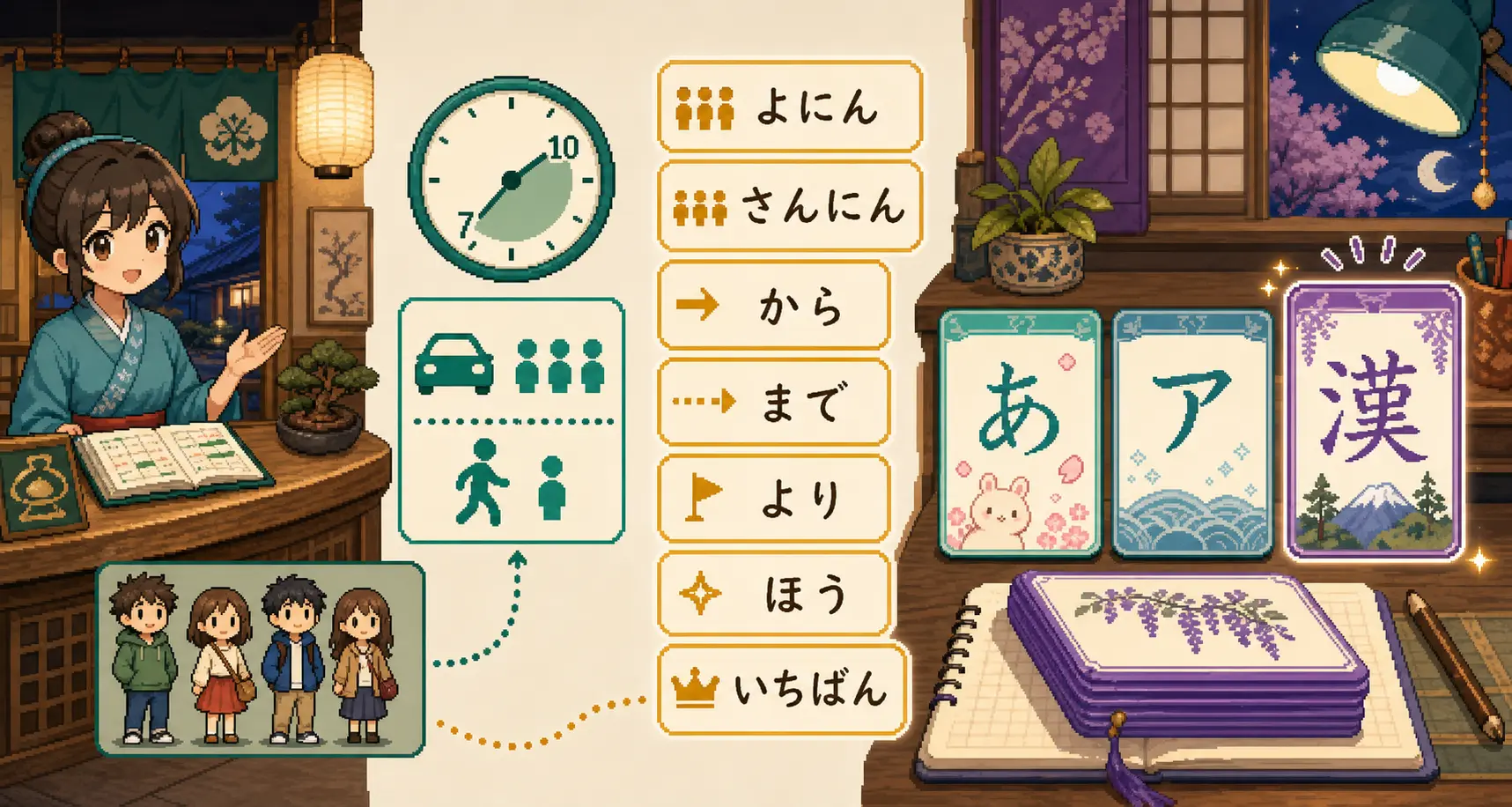
すみません、きょう の しちじ に よにん で よやく したい です。
Sumimasen, kyou no shichi-ji ni yo-nin de yoyaku shitai desu.
Excuse me, I'd like to make a reservation for four people at 7:00 today.
はい。しちじ から くじ まで です か。
Hai. Shichi-ji kara ku-ji made desu ka?
Yes. Is that from 7:00 until 9:00?
いいえ、じゅうじ まで おねがいします。さんにん は くるま で きます。わたし は あるいて いきます。
Iie, juu-ji made onegaishimasu. San-nin wa kuruma de kimasu. Watashi wa aruite ikimasu.
No, until 10:00, please. Three people will come by car. I will go on foot.
わかりました。おまちして おります。
Wakarimashita. Omachishite orimasu.
Understood. We look forward to seeing you.
スミスさん、にほんご の べんきょう は どう ですか。
Sumisu-san, nihongo no benkyou wa dou desu ka?
Mr. Smith, how is your Japanese study going?
むずかしい です。とくに かんじ が いちばん むずかしい です。
Muzukashii desu. Tokuni kanji ga ichiban muzukashii desu.
It's difficult. Especially kanji is the most difficult.
ひらがな と カタカナ と どちら が すき です か。
Hiragana to katakana to dochira ga suki desu ka?
Which do you like more: Hiragana or Katakana?
ひらがな の ほう が すき です。カタカナ より かわいい です から。
Hiragana no hou ga suki desu. Katakana yori kawaii desu kara.
I like Hiragana more. Because it's cuter than Katakana.
Chapter Summary
- 1Counting people uses 〜人 (nin); 1 and 2 are irregular (hitori, futari).
- 2Durations use suffixes like 〜時間 (hours), 〜週間 (weeks), and 〜ヶ月 (months).
- 3Use より (yori) to mean 'than' when comparing two things.
- 4Use 〜の ほう が (...no hou ga) to highlight the superior or preferred alternative.
- 5いちばん (ichiban) indicates the superlative (the most/best).
- 6In gift-giving, avoid the numbers 4 and 9 due to their unlucky associations.
Knowledge Check
Test your skills with people, time, and comparison!
How do you say 'two people' in Japanese?
Practice Quiz
How do you say 'two people' in Japanese?
- ににん
- ふたり
- ひとつ
- ふたつ
Which particle means 'than' in a comparison?
- から
- まで
- より
- ほう
How do you say 'three hours'?
- さんじ
- さんじかん
- さんにん
- さんしゅう
Translate: 'I like dogs more than cats.'
- いぬ は ねこ より すき です。
- いぬ と ねこ と どちら が すき です か。
- いぬ が いちばん すき です。
- いぬ は ねこ ほう です。
Which number is considered unlucky for gifts because it sounds like 'death'?
- 3
- 4
- 7
- 8
Translate: 'ひとり で いきました。'
- I went with a friend.
- I went alone.
- I went with two people.
- Who went?
How do you say 'the most' or 'number one'?
- とても
- ちょっと
- いちばん
- あまり
How many people are in 'よにん'?
- 3
- 4
- 5
- 8
Translate: 'Which is faster: the bus or the train?'
- バス と でんしゃ と どちら が はやい です か。
- バス は でんしゃ より はやい です。
- でんしゃ の ほう が はやい です。
- バス は はやい です。
How do you say 'one month'?
- いちがつ
- いっしゅうかん
- いっかげつ
- いちにち
Translate: 'Hokkaido is the coldest.'
- ほっかいどう は とても さむい です。
- ほっかいどう が いちばん さむい です。
- ほっかいどう は とうきょう より さむい です。
- ほっかいどう の ほう が さむい です。
Which of these is used for 'one person'?
- いちにん
- ひとつ
- ひとり
- いちまい
Translate: 'It takes two weeks.'
- にじかん かかります。
- にしゅうかん かかります。
- にかげつ かかります。
- ににん かかります。
In the phrase 'A no hou ga...', what does 'hou' literally mean?
- Fast
- Side / Alternative
- Better
- Than
True or False: In Japan, you should give gifts in sets of 9 to show great respect.
- True
- False
Applied review
Use what you learned
Focus: Duration and comparison. Try the task before revealing the model.
Produce the Japanese sentence, then compare it with the model answer.
1.Say “This train is faster than the bus.”
Duration and comparison in context
N5 mini-reading
- About how long does the journey take?