Giving & Receiving (あげる, もらう, くれる)
Learning objectives
- Learn to express giving something to someone using あげる.
- Learn to express receiving something from someone using もらう.
- Understand the special verb for someone giving to YOU using くれる.
- Combine these with the て-form to express giving and receiving actions/favors.
In English, the words “give” and “receive” are straightforward. But in Japanese, giving and receiving depend heavily on direction and perspective. The words change depending on whether an item (or favor) is moving away from the speaker, moving toward the speaker, or being received by the speaker. This trio of verbs—あげる, もらう, and くれる—is one of the most critical concepts for sounding natural in Japanese.
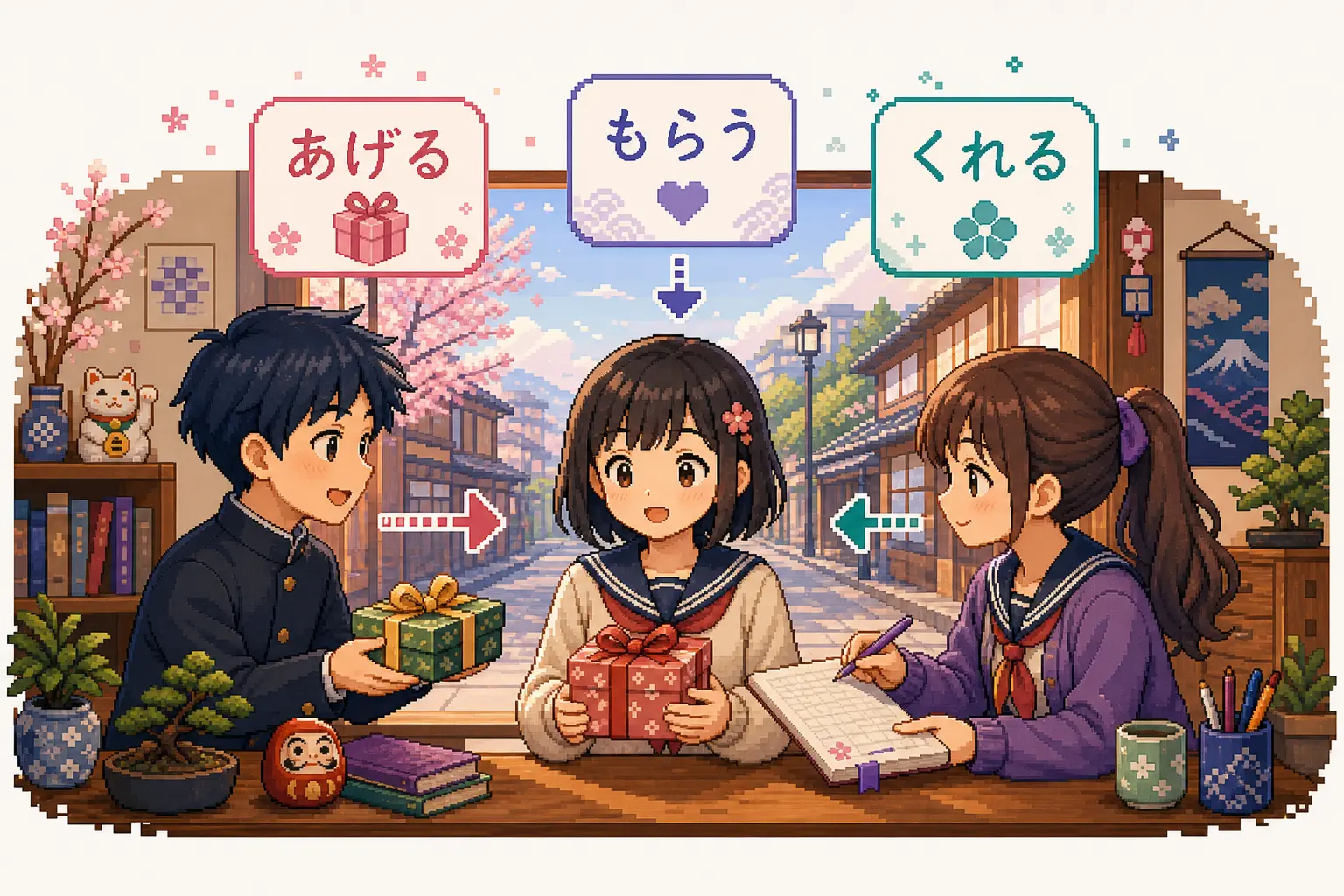
1. Giving Outward: あげる (Ageru)
When the speaker (or someone close to the speaker) gives something to someone else, use あげる. The perspective is moving outward and away from you.
Particle Rule:
[Giver] は [Receiver] に [Object] を あげる
means A gives [Object] to B (moving outward away from speaker).
Formation
Noun を あげる
私は友達にプレゼントをあげました。
watashi wa tomodachi ni purezento o agemashita.
I gave a present to my friend.
田中さんは鈴木さんに本をあげます。
Tanaka-san wa Suzuki-san ni hon o agemasu.
Mr. Tanaka will give a book to Mr. Suzuki.
母は花に水をあげました。
haha wa hana ni mizu o agemashita.
My mother watered the flowers (gave water to the flowers).
[!WARNING] You NEVER use
あげるwhen someone gives something to YOU. It is strictly for outward giving.
2. Receiving: もらう (Morau)
When someone receives something from someone else, use もらう. The mental focus is on the receiver’s gratitude.
Particle Rule:
[Receiver] は [Giver] に/から [Object] を もらう
(You can use に or から interchangeably for the giver, though から is mandatory if the giver is an institution/organization like a school or company).
means Receiver receives [Object] from Giver.
Formation
Noun を もらう
私は友達から花をもらいました。
watashi wa tomodachi kara hana o moraimashita.
I received flowers from my friend.
妹は母にお金をもらいます。
imouto wa haha ni okane o moraimasu.
My younger sister receives money from my mother.
誕生日に姉から辞書をもらいました。
tanjoubi ni ane kara jisho o moraimashita.
I received a dictionary from my older sister on my birthday.
3. Giving Inward (To Me): くれる (Kureru)
This is the tricky one! When someone gives something specifically to you (or your family/in-group), you MUST use くれる instead of あげる. The perspective is moving inward toward the speaker.
Particle Rule:
[Giver] は 私に [Object] を くれる
Often, the “私に” (to me) is omitted because くれる already heavily implies it.
means Giver gives [Object] to me (moving inward).
Formation
Noun を くれる
田中さんが(私に)時計をくれました。
Tanaka-san ga (watashi ni) tokei o kuremashita.
Mr. Tanaka gave me a watch.
先生が兄に辞書をくれました。
sensei ga ani ni jisho o kuremashita.
The teacher gave a dictionary to my older brother (in-group).
誕生日に父がカメラをくれました。
tanjoubi ni chichi ga kamera o kuremashita.
My father gave me a camera on my birthday.
Cultural Insight: The Culture of Gift Giving (贈答文化)
In Japan, gift-giving is a sophisticated social ritual. It’s not just about the object, but about the relationship.
- Omiyage (お土産): When traveling, Japanese people almost always buy souvenirs (usually local snacks) to give to colleagues and family. It shows that you were thinking of them while away.
- Temiyage (手土産): When visiting someone’s home, it is customary to bring a small gift.
- Return Gifts (Okaeshi): When you receive a gift (like for a wedding or birth), it is common to give a return gift (Okaeshi) worth about half the value of the original gift.
Using くれる and もらう correctly expresses the appropriate level of gratitude and acknowledges the social bonds maintained by these exchanges.
4. Giving and Receiving Favors (て-form applied)
The true power of this trio is that they combine with the て-form of verbs. Instead of giving physical things, you are giving and receiving actions or favors.
- 〜てあげる: I do a favor for someone else.
- 〜てもらう: I receive the favor of someone doing something for me.
- 〜てくれる: Someone does something for me.
私は友達の宿題を手伝ってあげました。
watashi wa tomodachi no shukudai o tetsudatte agemashita.
I helped my friend with their homework (I gave the favor of helping).
私は田中さんに日本語を教えてもらいました。
watashi wa Tanaka-san ni nihongo o oshiete moraimashita.
I had Mr. Tanaka teach me Japanese (I received the favor of him teaching).
田中さんが(私に)日本語を教えてくれました。
Tanaka-san ga (watashi ni) nihongo o oshiete kuremashita.
Mr. Tanaka taught me Japanese (He kindly gave the favor of teaching me).
Contextual Dialogues
Dialogue 1: Birthday Gifts (誕生日のプレゼント)
田中さん、誕生日おめでとう。これはプレゼントです。
Tanaka-san, tanjoubi omedetou. Kore wa purezento desu.
Tanaka-san, happy birthday! This is a present for you.
ありがとう!まだ誰にもプレゼントをもらっていなかったから、とても嬉しいです。
Arigatou! Mada dare ni mo purezento o moratte inakatta kara, totemo ureshii desu.
Thank you! I am very happy because nobody else has given me anything yet.
本当ですか?家族は何もくれませんでしたか。
Hontou desu ka? Kazoku wa nanimo kuremasen deshita ka.
Really? Didn't your family give you anything?
あ、妹がケーキを作ってくれました!
A, imouto ga keeki o tsukutte kuremashita!
Ah, my younger sister made a cake for me!
いいですね。私も家族にケーキを作ってもらいたいです。
Ii desu ne. Watashi mo kazoku ni keeki o tsukutte moraitai desu.
That sounds nice. I also want my family to make me a cake.
Dialogue 2: Asking for a Favor (お願い)
佐藤さん、この日本語が少し難しいです。手伝ってくれませんか。
Satou-san, kono nihongo ga sukoshi muzukashii desu. Tetsudatte kuremasen ka.
Sato, this Japanese is a bit difficult. Could you help me?
いいですよ。教えてあげます。
Ii desu yo. Oshiete agemasu.
Sure. I will teach you.
ありがとうございます!佐藤さんに教えてもらって、よかったです。
Arigatou gozaimasu! Satou-san ni oshiete moratte, yokatta desu.
Thank you! I'm glad I had you teach me.
いいえ。私の兄も、前によく手伝ってくれましたよ。
Iie. Watashi no ani mo, mae ni yoku tetsudatte kuremashita yo.
Don't mention it. My older brother also helped me often before.
優しいお兄さんですね。
Yasashii oniisan desu ne.
You have a kind brother.
Chapter Summary
- 1あげる is used for giving outward, away from the speaker.
- 2もらう is used to focus on the receiver getting something from a giver.
- 3くれる is specifically used when someone gives something to YOU or your inner circle.
- 4When combined with the て-form of verbs, they express the exchange of favors and actions instead of physical objects.
- 5Japanese gift culture (Omiyage, Okaeshi) is deeply linked to these linguistic structures.
Knowledge Check
Test your understanding of directional giving and receiving!
Which word do you use if YOU give a present to your friend?
Practice Quiz
Which word do you use if YOU give a present to your friend?
- くれました
- もらいました
- あげました
- きました
Which word do you use if your friend gives a present to YOU?
- くれました
- あげました
- いきました
- しました
What is the primary difference between もらう and くれる?
- もらう is for physical objects, くれる is for actions.
- They are the exact same word in different tenses.
- In もらう, the Receiver is the subject. In くれる, the Giver is the subject.
- もらう is used for enemies; くれる is used for friends.
Translate: 'I received flowers from Mr. Tanaka.'
- 私は田中さんに花をあげました。
- 私は田中さんに花をもらいました。
- 田中さんから花をくれました。
- 田中さんは私に花をもらいました。
Which particle is used to mark the GIVER when the sentence subject is the RECEIVER (using もらう)?
- は
- を
- に / から
- が
Translate: 'Mr. Tanaka taught me Japanese' using くれる.
- 田中さんが日本語を教えてくれました。
- 私は田中さんに日本語を教えてもらいました。
- 田中さんは日本語を教えてあげました。
- 私が田中さんに日本語を教えてくれました。
In the dialogue, why did Suzuki say '何もくれませんでしたか'?
- Because Tanaka didn't give anything to Suzuki.
- Because he is asking if the family gave anything TO Tanaka (the speaker's perspective).
- Because he is talking about sending a letter.
- It was a typo.
If a company or school gives you something, which particle MUST be used with もらう to indicate the giver?
- が
- を
- に
- から
Translate: 'I helped my younger brother with his homework.'
- 弟の宿題を手伝ってあげました。
- 弟が宿題を手伝ってくれました。
- 弟に宿題を手伝ってもらいました。
- 弟の宿題を手伝ってみました。
If you want to respectfully say 'I had the teacher look at my essay', which structure do you use?
- 見てあげました
- 見てもらいました
- 見てくれました
- 見てしまいました
Why should you be careful using '〜てあげる' with superiors (like a boss or teacher)?
- Because it is grammatically incorrect.
- Because it sounds like you are being condescending or highlighting your own kindness.
- Because it means 'to receive'.
- Because it is only used for animals.
In the sentence '田中さんは鈴木さんにプレゼントを___', which verb fits if no one is related to the speaker?
- くれました
- もらいました
- あげました
- きました
Which of these sentences is structurally WRONG?
- 私は田中さんに本をあげました。
- 先生は(私に)辞書をくれました。
- 私は田中さんに本をくれました。
- 私は先生から辞書をもらいました。
What does '妹がケーキを作ってくれました' imply?
- My sister made a cake for someone else.
- My sister bought a cake for me.
- My sister kindly made a cake for me.
- I made a cake for my sister.
If you are the subject and you receive an item, the main verb is ALWAYS:
- あげる
- くれる
- もらう
- てみる
Applied review
Use what you learned
Focus: Giving and receiving. Try the task before revealing the model.
Produce the Japanese sentence, then compare it with the model answer.
1.Say “My friend helped me revise the report.”
Giving and receiving in context
N4 mini-reading
- What favour did the teacher do?