て-Form Extensions (The Power of TE)
Learning objectives
- Express trying something to see what it's like using 〜てみる.
- Describe completion or regret using 〜てしまう.
- Indicate advanced preparation using 〜ておく.
- Describe actions moving toward or away from the speaker with 〜てくる and 〜ていく.
In N5, you learned that the て-form (TE-form) connects sentences and makes requests (〜てください). In N4, the て-form acts as a powerful docking station. By attaching specific “auxiliary verbs” to it, you can express complex nuances like preparation, regret, direction, and trial. Let’s explore these five essential extensions!
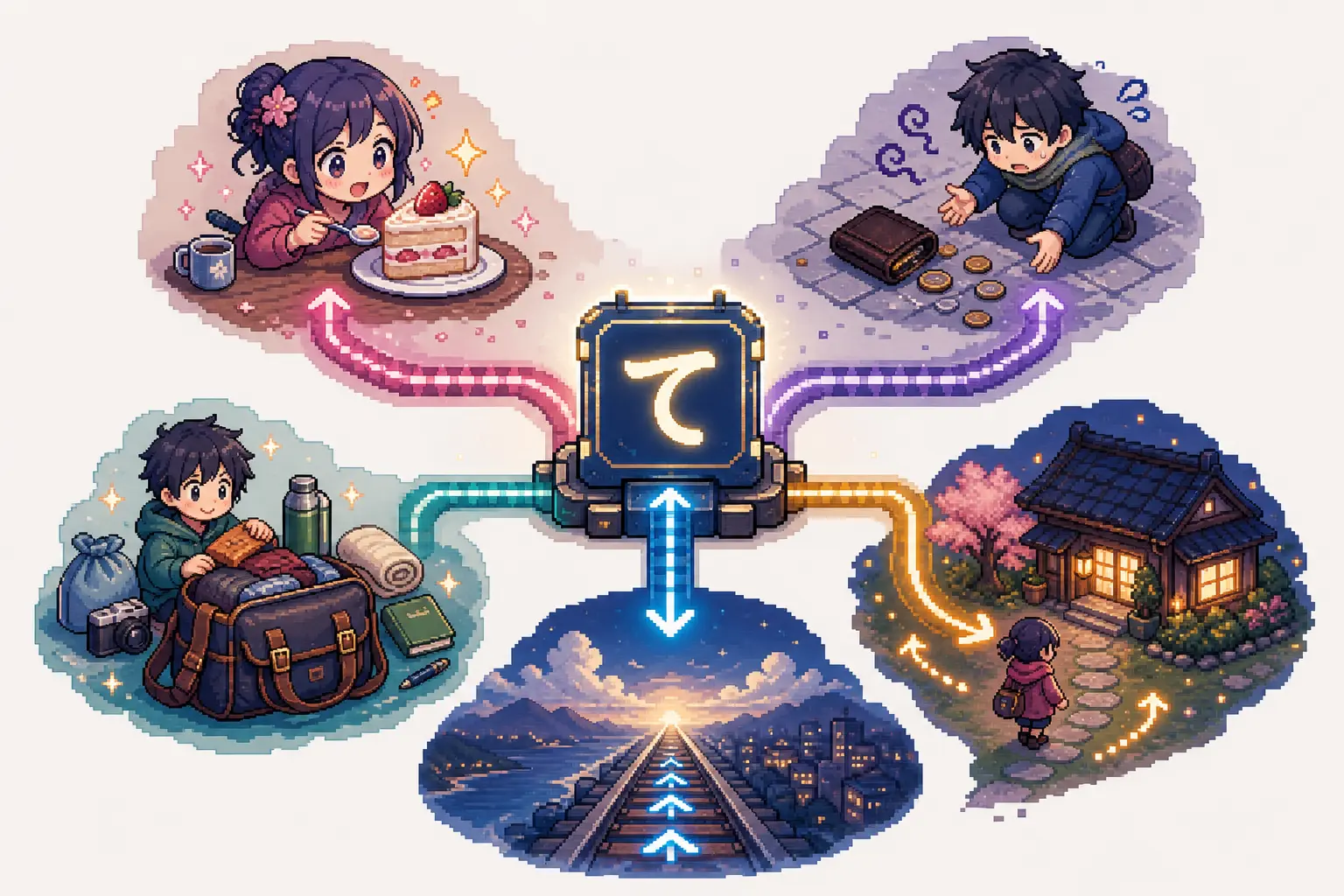
1. Trying Something: 〜てみる
When you do something as an experiment to see what it is like, use 〜てみる. This comes from the verb 見る (to see), but when used as an auxiliary, it is usually written in hiragana (みる).
means To try doing [verb] to see what happens / what it's like.
Formation
食べる → 食べてみる (Try eating)
このケーキを食べてみてください。
kono keeki o tabete mite kudasai.
Please try eating this cake.
あの新しいレストランへ行ってみます。
ano atarashii resutoran e itte mimasu.
I am going to try going to that new restaurant.
サイズが合うか、着てみました。
saizu ga au ka, kite mimashita.
I tried wearing it to see if the size fits.
[!NOTE]
〜てみるconjugates just like a normal Group 2 (ru-verb). You can sayてみます,てみない,てみたい(want to try doing), etc.
2. Regret or Completion: 〜てしまう
The extension 〜てしまう has two distinct meanings depending on the context:
- Regret/Oops: Doing something accidentally or unfortunately.
- Completion: Finishing an action completely and thoroughly.
In casual speech, 〜てしまう contracts to 〜ちゃう, and 〜でしまう contracts to 〜じゃう.
means To do [verb] completely, OR to do [verb] accidentally / with regret.
Formation
忘れる → 忘れてしまう (Forget completely / Unfortunately forget)
ごめんなさい、パスポートを忘れてしまいました。
gomennasai, pasupooto o wasurete shimaimashita.
I'm sorry, I accidentally forgot my passport.
ビールを全部飲んでしまいました。
biiru o zenbu nonde shimaimashita.
I completely drank all the beer.
あ!ケーキ食べちゃった!
a! keeki tabechatta!
Ah! I accidentally ate the cake! (Casual)
3. Preparation: 〜ておく
When you do an action in preparation for the future, use 〜ておく. It implies leaving something in a certain state so that it is ready later. In casual speech, it contracts to 〜とく.
means To do [verb] in advance / as preparation.
Formation
買う → 買っておく (Buy in advance)
パーティーの前に、飲み物を買っておきます。
paatii no mae ni, nomimono o katte okimasu.
Before the party, I will buy drinks in advance.
ホテルを予約しておきました。
hoteru o yoyaku shite okimashita.
I booked the hotel in advance.
ドアを開けておいてください。
doa o akete oite kudasai.
Please leave the door open (for future convenience).
Cultural Insight: The Concept of Dandori (段取り)
Japanese culture places a high value on Dandori (段取り), which refers to “preparation and planning.” Using 〜ておく reflects this cultural mindset. Whether it’s setting up a meeting room 15 minutes early or buying a gift weeks before a birthday, performing actions in advance is seen as a sign of consideration for others and professional competence.
4. Movement in Time/Space: 〜てくる and 〜ていく
These two extensions describe the direction of an action from the speaker’s perspective, either physically or temporally.
A. 〜てくる (Toward the speaker / Up to now)
- Physical: Do an action and then come back (
行ってきます). - Temporal: A change that has been happening up until now, or something starting to happen (
雨が降ってきた).
ちょっとコンビニへ行ってきます。
chotto konbini e itte kimasu.
I'm going to the convenience store and coming right back.
急に雨が降ってきました。
kyuu ni ame ga futte kimashita.
It suddenly started raining (the rain came toward us in time).
日本語が少しずつわかってきました。
nihongo ga sukoshizutsu wakatte kimashita.
I've gradually started to understand Japanese (up until now).
B. 〜ていく (Away from the speaker / From now on)
- Physical: Do an action and move away from the current location.
- Temporal: A change that will continue to happen from now into the future.
日本の人口は減っていくでしょう。
nihon no jinkou wa hette iku deshou.
The Japanese population will continue to decrease (into the future).
会社にお弁当を持っていきます。
kaisha ni obentou o motte ikimasu.
I will take a bento to the company (taking it away from current location).
これからも日本語を勉強し続けていきます。
korekara mo nihongo o benkyou shitsudukete ikimasu.
I will continue to keep studying Japanese from now on.
Contextual Dialogues
Dialogue 1: Preparing for a Trip (旅行の準備)
鈴木さん、コンサートのチケットは大丈夫ですか。
Suzuki-san, konsaato no chiketto wa daijoubu desu ka.
Suzuki, are our concert tickets okay?
はい、昨日買っておきましたよ。
Hai, kinou katte okimashita yo.
Yes, I bought them in advance yesterday.
よかった!あ、しまった!財布を忘れてしまいました!
Yokatta! A, shimatta! Saifu o wasurete shimaimashita!
That's a relief! Oh no, I accidentally forgot my wallet!
本当ですか?じゃあ、もう一度カバンの中を見てみてください。
Hontou desu ka? Jaa, mou ichido kaban no naka o mite mite kudasai.
Really? Then, please try looking in your bag one more time.
あ、ありました。すみません。じゃあ、ちょっとコーヒーを買ってきますね。
A, arimashita. Sumimasen. Jaa, chotto koohii o katte kimasu ne.
Ah, here it is. Sorry about that. Well then, I will go buy some coffee and come back.
Dialogue 2: Change Over Time (最近の変化)
最近、ずいぶん寒くなってきましたね。
Saikin, zuibun samuku natte kimashita ne.
It's become quite cold recently, hasn't it?
ええ。これから、もっと寒くなっていきますよ。
Ee. Korekara, motto samuku natte ikimasu yo.
Yes. From now on, it will continue to get even colder.
そろそろ、新しいコートを買ってみようと思っています。
Sorosoro, atarashii kooto o kattemiyou to omotte imasu.
I should try buying a new coat soon.
私はもう買っておきましたよ。冬の準備は大丈夫です。
Watashi wa mou katte okimashita yo. Fuyu no junbi wa daijoubu desu.
I've already bought mine in advance. I'm ready for winter.
準備がいいですね!私は季節を忘れてしまっていました。
Junbi ga ii desu ne! Watashi wa kisetsu o wasurete shimatte imashita.
You are well-prepared! I've completely lost track of the season.
Chapter Summary
- 1〜てみる means to try doing something to see what happens.
- 2〜てしまう indicates either completing an action entirely or doing it accidentally/with regret.
- 3〜ておく indicates doing something in advance as preparation (Dandori).
- 4〜てくる shows action moving toward the speaker or a change continuing up to the present.
- 5〜ていく shows action moving away from the speaker or a change continuing into the future.
Knowledge Check
Test your understanding of the て-Form extensions!
Which form implies you are doing something in advance for preparation?
Practice Quiz
Which form implies you are doing something in advance for preparation?
- 〜てみる
- 〜ておく
- 〜てしまう
- 〜てくる
Translate: 'I accidentally dropped my phone.'
- スマホを落としておきました。
- スマホを落としてみました。
- スマホを落としてしまいました。
- スマホを落としてきました。
What is the casual contraction of '食べてしまう'?
- 食べとく
- 食べちゃう
- 食べじゃう
- 食べみく
If you want to say 'Please try eating this.', you say:
- 食べてきてください
- 食べておいてください
- 食べてみてください
- 食べていってください
Which phrase means 'I am going to buy it and come back'?
- 買っていきます
- 買ってみます
- 買っておきます
- 買ってきます
What nuance does '窓(まど)を開けておく' imply?
- I accidentally left the window open.
- I will try opening the window.
- I will leave the window open (for future convenience/ventilation).
- I am opening the window right now.
If an ongoing trend will continue from now into the future, which extension is used?
- 〜てみる
- 〜ておく
- 〜てくる
- 〜ていく
Translate: 'ケーキを全部食べてしまった。'
- I tried to eat the whole cake.
- I left the cake for later.
- I completely ate the whole cake.
- The cake is coming toward me.
What is the casual spoken form of '買っておく' (to buy in advance)?
- 買っちゃう
- 買っとく
- 買ってみる
- 買ってく
Which extension comes from the verb 'to see'?
- 〜てしまう
- 〜てみる
- 〜ておく
- 〜てくる
In the dialogue, why did Suzuki say '買っておきました'?
- Because he bought the tickets accidentally.
- Because he bought the tickets in preparation for the concert.
- Because he tried buying tickets.
- Because he dropped the tickets.
What is the correct contraction for '飲んでしまう'?
- 飲んじゃう
- 飲みちゃう
- 飲んどく
- 飲んでみる
If the clouds gather and it starts raining right now, which is correct?
- 雨が降っていきました。
- 雨が降ってきました。
- 雨が降ってみました。
- 雨が降っておきました。
Which of these expresses 'I want to try going to Japan'?
- 日本へ行ってしまいます。
- 日本へ行っておきたいです。
- 日本へ行ってみます。
- 日本へ行ってみたいです。
If you take an umbrella with you when you leave your house, you literally 'hold and go'. How is this written?
- 持っていきます
- 持ってきます
- 持っておきます
- 持ってみます
Applied review
Use what you learned
Focus: て-form extensions. Try the task before revealing the model.
Produce the Japanese sentence, then compare it with the model answer.
1.Say “I booked the hotel in advance.”
て-form extensions in context
N4 mini-reading
- What went wrong with the trial?