Adjectives Part 1: い-Adjectives
Learning objectives
- Identify い-Adjectives and distinguish them from other word groups.
- Conjugate い-Adjectives into present, past, and negative forms.
- Use adjectives to modify nouns directly.
- Appreciate the cultural connection between adjectives and the four seasons.
In Japanese, adjectives are more than just describing words—they are like mini-verbs! They can change their endings to show if something is hot, was hot, or is not hot. There are two main groups of adjectives, and today we are focusing on the first group: い-Adjectives (i-adjectives). These words always end in the hiragana character い and are incredibly versatile.
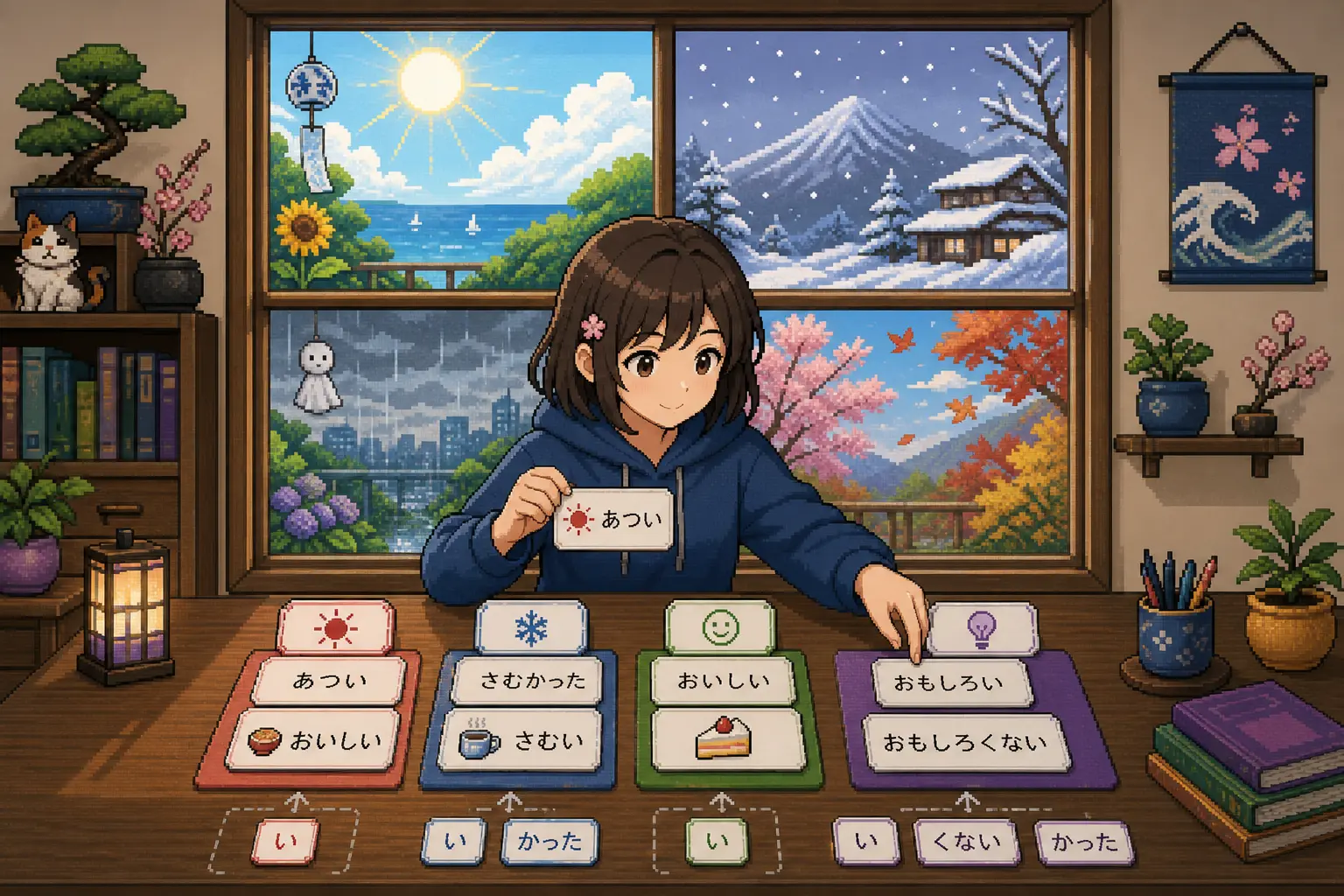
1. What are い-Adjectives?
い-adjectives normally end in the hiragana い and conjugate by changing that ending. However, not every word ending in い is an い-adjective: common な-adjectives such as きれい and ゆうめい must be learned separately. Japanese adjectives do not literally contain “is”; rather, い-adjectives can form a plain predicate without a copula.
たかい
い-Adjtakai
Expensive / Tall
やすい
い-Adjyasui
Cheap
おいしい
い-Adjoishii
Delicious
あつい
い-Adjatsui
Hot
さむい
い-Adjsamui
Cold
おもしろい
い-Adjomoshiroi
Interesting
この すし は おいしい です。
Kono sushi wa oishii desu.
This sushi is delicious.
あの ビル は たかい です。
Ano biru wa takai desu.
That building over there is tall.
きょう は あつい です ね。
Kyou wa atsui desu ne.
It's hot today, isn't it?
2. Conjugating い-Adjectives
Unlike nouns, you change the adjective itself to show tense. To conjugate, you drop the final い and add a new ending.
| Tense | Ending | Example (たかい) | Meaning |
|---|---|---|---|
| Present Affirmative | 〜い (desu) | たかい です | Is expensive |
| Present Negative | 〜くない (desu) | たかくない です | Is not expensive |
| Past Affirmative | 〜かった (desu) | たかかった です | Was expensive |
| Past Negative | 〜くなかった (desu) | たかくなかった です | Was not expensive |
means Conjugating for tense and negativity.
Formation
Drop the final 'i' and attach the appropriate suffix.
きのう は さむかった です。
Kinou wa samukatta desu.
Yesterday was cold.
この ほん は おもしろくない です。
Kono hon wa omoshirokunai desu.
This book is not interesting.
テスト は むずかしくなかった です。
Tesuto wa muzukashikunakatta desu.
The test was not difficult.
あさごはん は やすかった です。
Asagohan wa yasukatta desu.
Breakfast was cheap.
えいが は おもしろかった です か。
Eiga wa omoshirokatta desu ka.
Was the movie interesting?
コーヒー は つめたくない です。
Koohii wa tsumetakunai desu.
The coffee is not cold.
3. Direct Noun Modification
To describe a noun directly (e.g., “A delicious apple”), you simply place the adjective in its dictionary form directly before the noun. No particle is needed!
means Modifying a noun directly.
Formation
Dictionary form adjective + Noun.
おいしい りんご です。
Oishii ringo desu.
It is a delicious apple.
たかい とけい を かいました。
Takai tokei o kaimashita.
I bought an expensive watch.
あつい おちゃ を のみます。
Atsui ocha o nomimasu.
I drink hot tea.
おもしろい ほん を よみました。
Omoshiroi hon o yomimashita.
I read an interesting book.
さむい くに に いきます。
Samui kuni ni ikimasu.
I am going to a cold country.
やすい カメラ は どこ です か。
Yasui kamera wa doko desu ka.
Where is a cheap camera?
4. Cultural Note: The Four Seasons and Nature (四季)
Japanese culture has a profound appreciation for the four seasons (Shiki). This is reflected in the language, where many adjectives are used to describe the specific “feeling” of a season.
- Haru (Spring): Associated with atatakai (warm) and utsukushii (beautiful) cherry blossoms.
- Natsu (Summer): Described as atsui (hot) and mushi-atsui (humid). Summer is the time for nigiyaka (lively) festivals.
- Aki (Autumn): Known for suzushii (cool) breezes and the kirei (beautiful) changing leaves.
- Fuyu (Winter): Characterized as samui (cold) and shiroi (white) snow.
- Kachou Fuugetsu (花鳥風月): A four-character idiom literally meaning “Flower, Bird, Wind, Moon.” It represents the traditional themes of natural beauty in Japanese aesthetics.
Conversation Practice
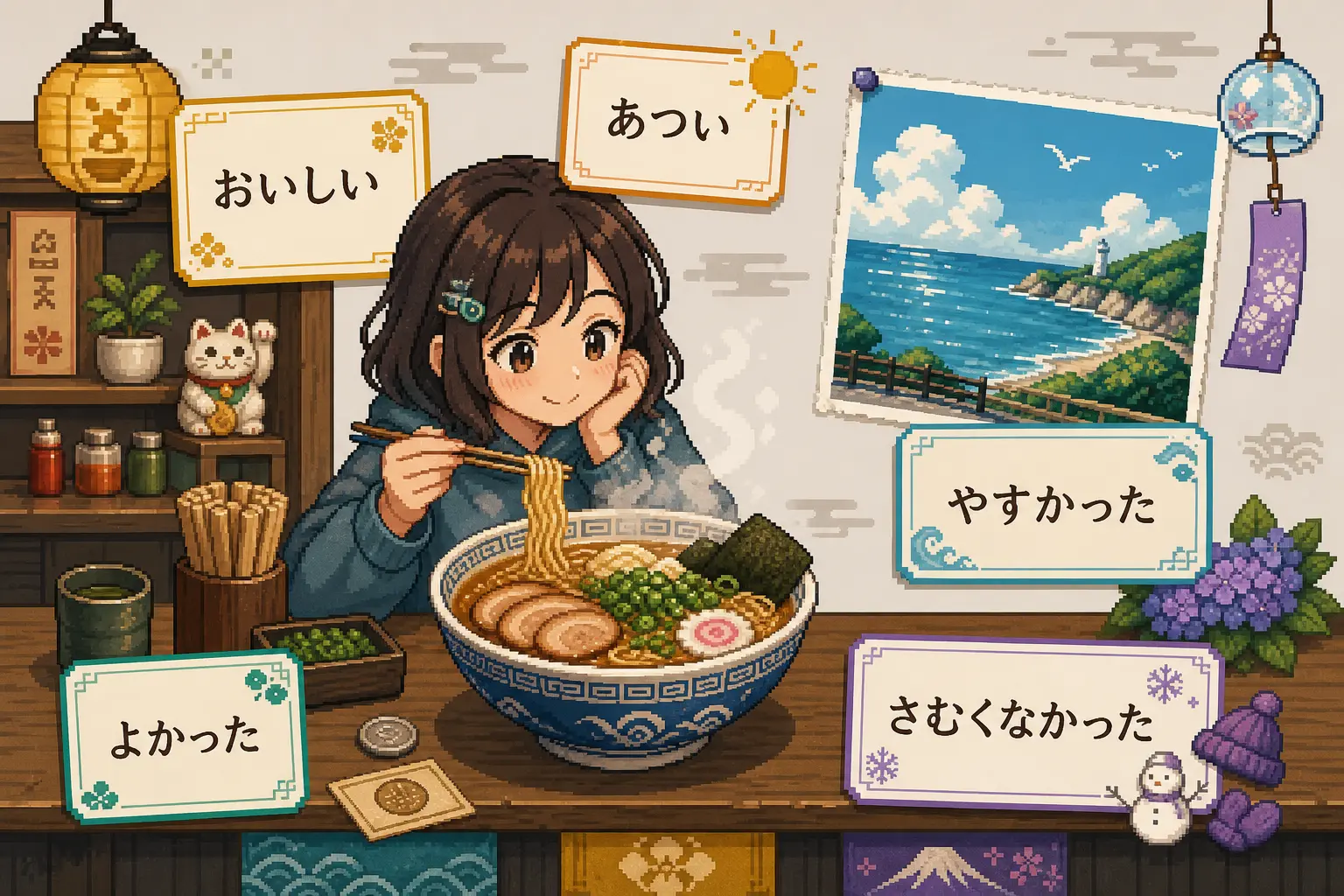
その ラーメン は おいしい です か。
Sono raamen wa oishii desu ka?
Is that ramen delicious?
はい、 とても おいしい です。 でも、 ちょっと あつい です。
Hai, totemo oishii desu. Demo, chotto atsui desu.
Yes, it's very delicious. But it's a bit hot.
たかい です か。
Takai desu ka?
Is it expensive?
いいえ、 やすかった です よ。 800えん です。
Iie, yasukatta desu yo. Happyaku-en desu.
No, it was cheap. It's 800 yen.
きのう、 どこ へ いきました か。
Kinou, doko e ikimashita ka?
Where did you go yesterday?
うみ へ いきました。 とても おもしろかった です!
Umi e ikimashita. Totemo omoshirokatta desu!
I went to the sea. It was very interesting!
てんき は よかった です か。
Tenki wa yokatta desu ka?
Was the weather good?
はい、 さむくなかった です。
Hai, samukunakatta desu.
Yes, it wasn't cold.
Chapter Summary
- 1い-adjectives normally end in hiragana い, but words such as きれい and ゆうめい are な-adjectives.
- 2To conjugate, drop the final い and add: 〜くない (neg), 〜かった (past), or 〜くなかった (past neg).
- 3Modify nouns directly by placing the adjective before the noun (e.g., おいしい すし).
- 4Japanese culture values the specific descriptive qualities of each of the four seasons.
- 5The word 'yoi' (good) is irregular; its root changes to 'yoku' in all forms except present affirmative.
Knowledge Check
Test your adjective conjugation skills!
Which of these is an い-Adjective?
Practice Quiz
Which of these is an い-Adjective?
- しずか
- きれい
- たかい
- べんり
How do you make 'あつい' (hot) negative ('is not hot')?
- あつい じゃありません
- あつくない
- あつくなかった
- あつい ない
What is the past tense of 'さむい' (cold)?
- さむい でした
- さむかった
- さむかったです
- さむくない
Translate: 'An interesting book.'
- おもしろい な ほん
- おもしろい の ほん
- おもしろい ほん
- おもしろい に ほん
Which tense is 'やすかった'?
- Present Affirmative
- Present Negative
- Past Affirmative
- Past Negative
How do you conjugate 'いい' (good) into the negative ('is not good')?
- いいくない
- よくない
- いくない
- よかったです
Translate: 'The test was not difficult.' (difficult = むずかしい)
- テスト は むずかしくなかった です。
- テスト は むずかしくない です。
- テスト は むずかしい じゃありません。
- テスト は むずかしかっだ です。
Which word means 'Cheap'?
- たかい
- やすい
- おいしい
- あつい
What does 'atsui' mean?
- Cold
- Warm
- Hot
- Cool
Fill in the blank: 'Kinou wa _____ desu.' (Yesterday was cold).
- さむい
- さむかった
- さむくない
- さむくなかった
What is 'Winter' in Japanese?
- はる
- なつ
- あき
- ふゆ
Translate: 'Utsukushii hana.'
- Hot flower
- Beautiful flower
- Interesting flower
- Cheap flower
Which is the correct past negative for 'おいしい'?
- おいしくない
- おいしかった
- おいしくなかった
- おいしい じゃありませんでした
How do you say 'It's hot, isn't it?'
- あつい です か。
- あつい です ね。
- あつい です よ。
- あつい です。
True or False: い-adjectives conjugate by changing the final 'i' to 'desu'.
- True
- False
Applied review
Use what you learned
Focus: い-adjective conjugation. Try the task before revealing the model.
Produce the Japanese sentence, then compare it with the model answer.
1.Say “Yesterday was not cold.”
い-adjective conjugation in context
N5 mini-reading
- How did the weather change?