Past Tense: Nouns & Verbs
Learning objectives
- Conjugate Nouns and な-adjectives into the past tense using でした.
- Conjugate い-adjectives into the past tense using かった.
- Master the polite verb past tense forms (ました and ませんでした).
- Learn about Japanese New Year (Oshougatsu) traditions and reflections.
To tell a story, you must be able to speak about the past. In Japanese, the way you “look back” depends on what kind of word you are using. Whether you are describing a state (“It was a holiday”), a feeling (“It was cold”), or an action (“I ate sushi”), this chapter provides the master key to all N5 past tense conjugations.
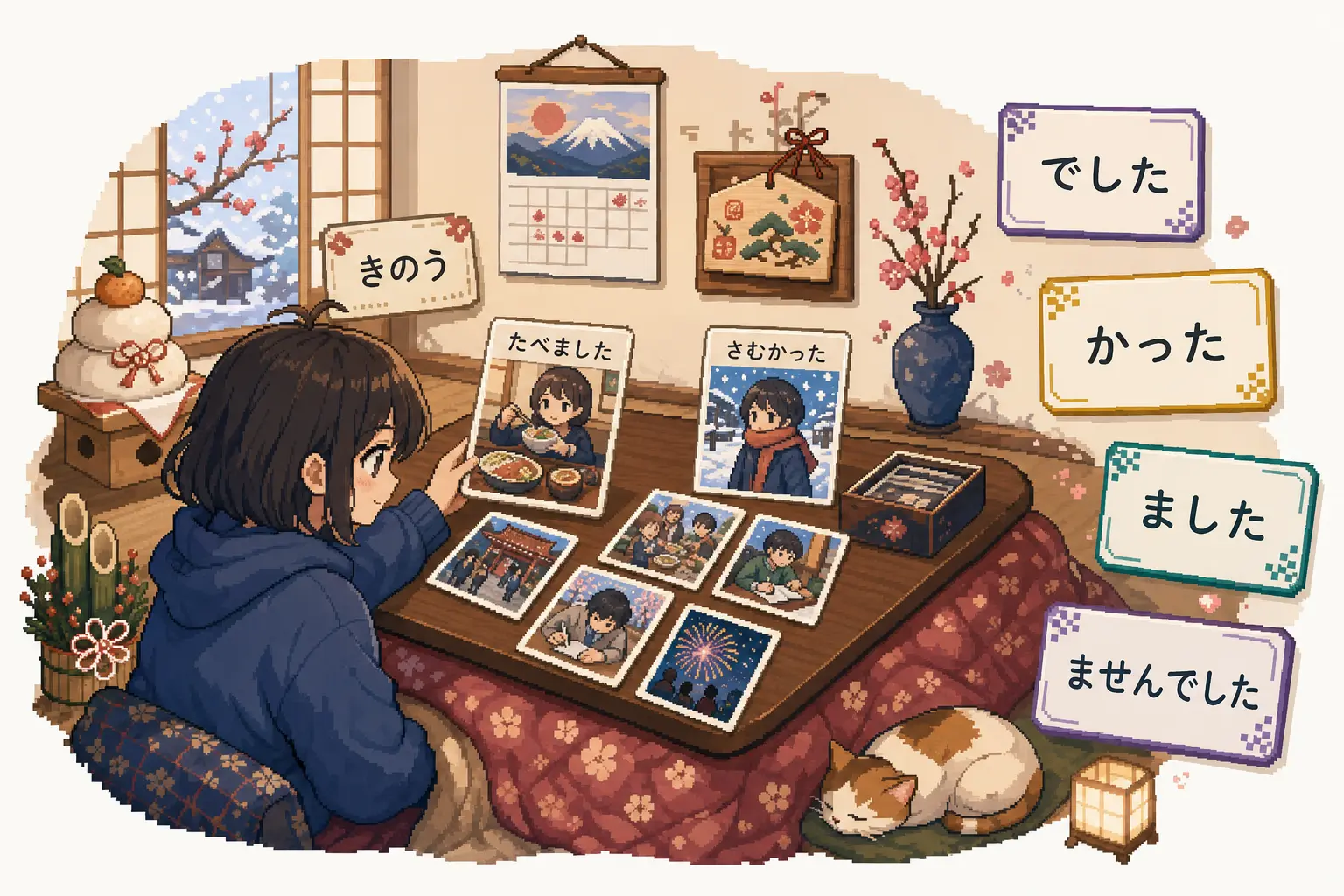
1. Past Tense for Nouns & な-Adjectives
Nouns and な-adjectives are “lazy” conjugators. They don’t change themselves; they rely entirely on the Copula (です) to change into the past tense.
- Affirmative: [Noun] でした (deshita)
- Negative: [Noun] じゃありませんでした (ja arimasen deshita)
means It was [Noun].
Formation
Noun + でした / じゃありませんでした
きのう は やすみ でした。
Kinou wa yasumi deshita.
Yesterday was a holiday.
あめ じゃありませんでした。
Ame ja arimasen deshita.
It was not rain.
にほんご の しけん は かんたん でした。
Nihongo no shiken wa kantan deshita.
The Japanese exam was easy.
こどものとき、しずか でした。
Kodomo no toki, shizuka deshita.
When I was a child, I was quiet.
パーティー は にぎやか でした か。
Paatii wa nigiyaka deshita ka?
Was the party lively?
せんしゅう は ひま じゃありませんでした。
Senshuu wa hima ja arimasen deshita.
I was not free last week.
2. Past Tense for い-Adjectives
Unlike nouns, い-adjectives change their own endings. To make them past tense, you must drop the final い and add かった (katta).
means It was [Adjective].
Formation
Drop い + add かった
あつかった です。
Atsukatta desu.
It was hot.
おもしろくなかった です。
Omoshirokunai desu ➔ Omoshirokunakatta desu.
It was not interesting.
てんき は よかった です。
Tenki wa yokatta desu.
The weather was good. (ii ➔ yokatta)
きのう の りょうり は おいしかった です。
Kinou no ryouri wa oishikatta desu.
Yesterday's meal was delicious.
テスト は むずかしくなかった です。
Tesuto wa muzukashikunakatta desu.
The test was not difficult.
きょねん の ふゆ は とても さむかった です。
Kyonen no fuyu wa totemo samukatta desu.
Last year's winter was very cold.
3. Past Tense for Verbs (ます-Form)
For polite verbs, the conjugation is consistent across all groups. You simply change the ます ending.
- Affirmative: 〜ました (mashita)
- Negative: 〜ませんでした (masen deshita)
means Performed the action in the past.
Formation
Stem + ました / ませんでした
すし を たべました。
Sushi o tabemashita.
I ate sushi.
どこ へ も いきませんでした。
Doko e mo ikimasen deshita.
I didn't go anywhere.
だれ と あいました か。
Dare to aimashita ka?
Who did you meet?
きのう は じゅうじ に ねました。
Kinou wa juu-ji ni nemashita.
Yesterday, I went to sleep at 10:00.
あさごはん を たべませんでした。
Asagohan o tabemasen deshita.
I didn't eat breakfast.
にほんご を たくさん べんきょうしました。
Nihongo o takusan benkyoushimashita.
I studied Japanese a lot.
4. Cultural Note: New Year Reflections (Oshougatsu)
In Japan, the New Year (Oshougatsu) is the most important holiday. It is a time for reflection on the past year and making wishes for the future.
- Hatsumode (初詣): The first shrine or temple visit of the year. People thank the gods for the past year’s safety and pray for a good new year.
- Osechi-ryouri (おせち料理): Special traditional foods eaten during the first three days. Each ingredient has a symbolic meaning related to health, fertility, or harvest.
- Nengajou (年賀状): New Year’s greeting cards. People write about what happened in the past year and express hopes for the next.
Language Tip: When reflecting, you will use the past tense constantly!
- Kyonen wa tanoshikatta desu. (Last year was fun.)
- Takusan benkyou shimashita. (I studied a lot.)
Conversation Practice
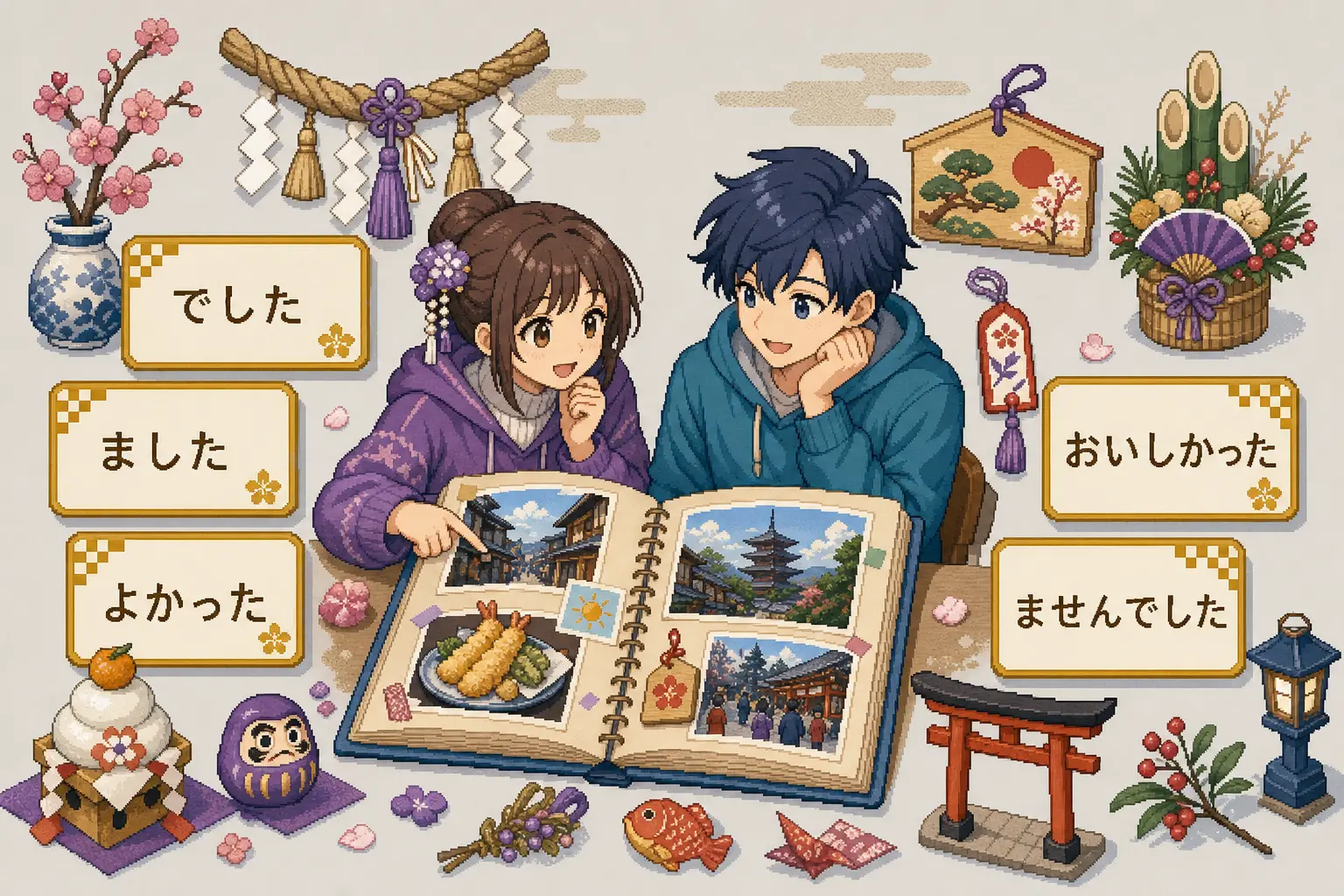
しゅうまつ は なに を しました か。
Shuumatsu wa nani o shimashita ka?
What did you do on the weekend?
きょうと へ いきました。 とても きれい でした よ。
Kyouto e ikimashita. Totemo kirei deshita yo.
I went to Kyoto. It was very beautiful.
てんき は よかった です か。
Tenki wa yokatta desu ka?
Was the weather good?
はい、あつかった です。 でも、おもしろかった です。
Hai, atsukatta desu. Demo, omoshirokatta desu.
Yes, it was hot. But it was interesting.
なに を たべました か。
Nani o tabemashita ka?
What did you eat?
てんぷら を たべました。 おいしかった です!
Tenpura o tabemashita. Oishikatta desu!
I ate tempura. It was delicious!
あけまして おめでとう ございます! きょねん は どんな とし でした か。
Akemashite omedetou gozaimasu! Kyonen wa donna toshi deshita ka?
Happy New Year! What kind of year was last year?
とても いそがしかった です。 でも、たのしかった です。
Totemo isogashikatta desu. Demo, tanoshikatta desu.
It was very busy. But it was fun.
わたし は あまり べんきょう しませんでした。 ことし は がんばります!
Watashi wa amari benkyou shimasen deshita. Kotoshi wa ganbarimasu!
I didn't study much. This year I'll work hard!
いっしょに はつもうで に いきませんか。
Isshoni hatsumoude ni ikimasenka?
Won't you go with me for the first shrine visit?
Chapter Summary
- 1Nouns and な-adjectives use でした (was) and じゃありませんでした (was not).
- 2い-adjectives drop the final い and add かった (was) or くなかった (was not).
- 3Polite verbs use ました (did) and ませんでした (did not).
- 4The adjective いい (good) becomes よかった (was good).
- 5Questions about the past maintain the same word order; just change the verb/adjective ending and add か.
- 6Japanese New Year is a time for reflecting on past events using these grammar forms.
Knowledge Check
Test your ability to describe the past!
How do you conjugate 'たべます' (to eat) into the past tense?
Practice Quiz
How do you conjugate 'たべます' (to eat) into the past tense?
- たべった
- たべました
- たべますでした
- たべましたでした
What is the past tense of the noun 'やすみ' (holiday/rest)?
- やすみかった
- やすみでした
- やすみした
- やすみでしたです
Translate: 'It was hot.' (あつい = hot)
- あつい でした
- あつくでした
- あつかった です
- あつかったですでした
What is the negative past tense of 'いきました' (went)?
- いきませんでした
- いきなかった
- いきませんでしたでした
- いきじゃありませんでした
Translate: 'Yesterday was not a holiday.'
- きのう は やすみ かった です。
- きのう は やすみ じゃありませんでした。
- きのう は やすみ でした。
- きのう は やすみ くなかった です。
How do you conjugate 'いい' (good) into 'was good'?
- いいかった
- よかった
- よくでした
- いくなかった
Translate: 'The movie was not interesting.' (おもしろい = interesting)
- えいが は おもしろくない でした。
- えいが は おもしろくなかった です。
- えいが は おもしろい じゃありませんでした。
- えいが は おもしろかった です。
Translate: 'Who did you meet?'
- だれ が あいました か。
- だれ と あいました か。
- だれ に あいました か。
- だれ を あいました か。
Which of the following describes a past action?
- べんきょうします
- べんきょうしました
- べんきょうしたい
- べんきょうして
Translate: 'It was lively.' (にぎやか = lively [な-adj])
- にぎやかかった
- にぎやか でした
- にぎやか かった です
- にぎやか に なりました
How do you say 'I didn't eat anything'?
- なにも たべませんでした。
- なんでも たべました。
- なにか たべませんでした。
- だれも たべませんでした。
What does 'Hatsumode' refer to?
- The first dream
- The first shrine visit
- Special New Year's food
- Greeting cards
Translate: 'Last week was busy.' (いそがしい = busy)
- せんしゅう は いそがしい でした。
- せんしゅう は いそがしかった です。
- せんしゅう は いそがしい かった。
- せんしゅう は いそがしかった でした。
If a sentence ends in '〜ませんでした', what do we know?
- It is present affirmative.
- It is past affirmative.
- It is past negative.
- It is a request.
True or False: Verbs and Adjectives use the same ending for the past tense.
- True
- False
Applied review
Use what you learned
Focus: Past tense. Try the task before revealing the model.
Produce the Japanese sentence, then compare it with the model answer.
1.Say “I went to Osaka, but I did not see Osaka Castle.”
Past tense in context
N5 mini-reading
- What two things did the speaker do in Kyoto?