Verb Groups & Dictionary Form
Learning objectives
- Understand what the 'Dictionary Form' of a verb is.
- Classify verbs into Group 1 (u-verbs), Group 2 (ru-verbs), or Group 3 (Irregular).
- Identify exceptions to the classification rules.
- Explore the concept of 'Ma' in Japanese language and rhythm.
In English, to know how to conjugate a verb, you only need to know it’s a verb (e.g., eat ➔ eating, ate, eaten). But in Japanese, knowing it’s a verb isn’t enough! Every single Japanese verb belongs to one of Three Groups. The group a verb belongs to determines exactly how it will conjugate for tense, politeness, and every other grammar rule you will ever learn.
You already used these groups to build the polite ます-form in Chapter 10. Here we formalize how to tell them apart, working from the Dictionary Form: the plain, unconjugated, casual form of the verb — the form you would look up in a dictionary. Master this and every later conjugation (て-form, potential, passive, causative…) falls into place. Let’s learn the groups!
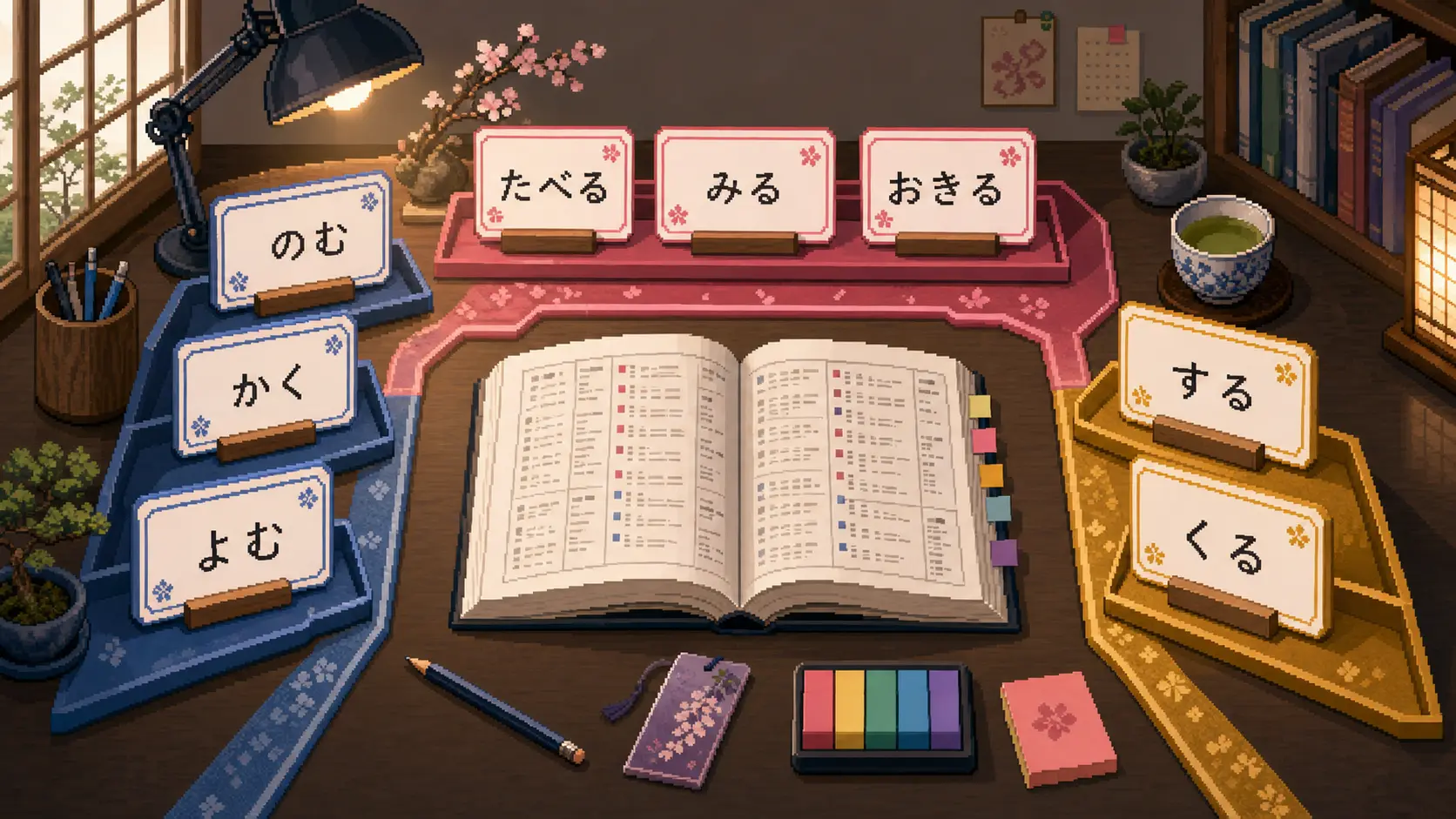
1. Group 1: The u-verbs (Godan Verbs)
Group 1 is the largest verb group. To identify a Group 1 verb, look at its Dictionary Form ending. If it ends in any Hiragana character from the “u” row (other than る), it is 100% guaranteed to be a Group 1 verb!
Common Endings:
- 〜く (ku): かく (to write)
- 〜す (su): はなす (to speak)
- 〜つ (tsu): まつ (to wait)
- 〜む (mu): のむ (to drink)
- 〜う (u): かう (to buy)
The Catch: Some Group 1 verbs do end in る (ru). If the sound right before the る is an “a”, “u”, or “o” sound, it is a Group 1 verb.
- わかる (wakaru) [to understand]
- つくる (tsukuru) [to make]
means Dictionary Form of Group 1 verbs.
Formation
The base form found in dictionaries.
みず を のむ。
Mizu o nomu.
I drink water. (Plain)
てがみ を かく。
Tegami o kaku.
I write a letter. (Plain)
くるま に のる。
Kuruma ni noru.
I ride in a car. (Plain)
としょかん で ほん を よむ。
Toshokan de hon o yomu.
I read a book at the library.
あした、 かいもの に いく。
Ashita, kaimono ni iku.
Tomorrow, I'll go shopping.
おんがく を きく。
Ongaku o kiku.
I listen to music.
2. Group 2: The ru-verbs (Ichidan Verbs)
Group 2 verbs are the easiest verbs to conjugate. They always end in る (ru). To identify a Group 2 verb, look at the sound right before the る. If it is an “i” sound or an “e” sound, then most of the time, it is a Group 2 verb!
- “i” sound + る: みる (mi-ru), おきる (oki-ru)
- “e” sound + る: たべる (tabe-ru), ねる (ne-ru)
means Dictionary Form of Group 2 verbs.
Formation
Roots ending in 'i' or 'e' sounds + る.
リンゴ を たべる。
Ringo o taberu.
I eat an apple. (Plain)
テレビ を みる。
Terebi o miru.
I watch TV. (Plain)
ベッド で ねる。
Beddo de neru.
I sleep in the bed. (Plain)
あさ、 しちじ に おきる。
Asa, shichi-ji ni okiru.
I wake up at 7:00 in the morning.
えいが を みる。
Eiga o miru.
I watch a movie.
ごはん を たべる。
Gohan o taberu.
I eat a meal.
[!WARNING] The Exceptions Trap! Some verbs look like Group 2 (end in i-ru or e-ru) but are secretly Group 1!
- かえる (kaeru) - To return home
- はいる (hairu) - To enter
- はしる (hashiru) - To run
3. Group 3: Irregular Verbs
There are only two irregular verbs in the entire Japanese language.
- する (suru) - To do
- くる (kuru) - To come
means The two irregular verbs in Japanese.
Formation
Memorize these two separately.
べんきょう を する。
Benkyou o suru.
I study.
テニス を する。
Tenisu o suru.
I play tennis.
あした くる。
Ashita kuru.
I will come tomorrow.
かいもの を する。
Kaimono o suru.
I do shopping.
ここに くる。
Koko ni kuru.
I come here.
さんぽ を する。
Sanpo o suru.
I take a walk.
4. Cultural Note: The Concept of ‘Ma’ (間)
In Japanese culture, Ma (間) refers to the “space,” “interval,” or “pause” between things. This concept is vital in everything from architecture and gardens to the Japanese language itself.
- In Language: ‘Ma’ is the silence between words or the pause before a verb. It allows the listener to process information and adds weight to what is said.
- In Rhythm: Japanese verbs often dictate the rhythm of a sentence. Understanding the group helps you maintain the correct ‘Ma’ during conjugation.
- In Art: A minimalist Japanese painting uses empty space (Ma) to highlight the subject. Similarly, a well-timed pause in conversation is seen as a sign of intelligence and respect.
Conversation Practice
あした、 なに を する?
Ashita, nani o suru?
What are you going to do tomorrow?
ほん を よむ。 たなかさん は?
Hon o yomu. Tanaka-san wa?
I'll read a book. How about you, Tanaka?
わたし は えいが を みる。 それから、 かいもの を する。
Watashi wa eiga o miru. Sorekara, kaimono o suru.
I will watch a movie. And then, I'll do some shopping.
いい ね。 いっしょ に たべる?
Ii ne. Issho ni taberu?
That's nice. Want to eat together?
毎日、 なんじ に おきる?
Mainichi, nanji ni okiru?
What time do you wake up every day?
ろくじ に おきる。 それから、 はしる。
Rokuji ni okiru. Sorekara, hashiru.
I wake up at 6:00. And then, I run.
すごい ね。 わたし は しちじ に おきる。
Sugoi ne. Watashi wa shichiji ni okiru.
That's impressive. I wake up at 7:00.
よる は いつ ねる?
Yoru wa itsu neru?
When do you go to sleep at night?
Chapter Summary
- 1Japanese verbs are classified into three groups: Group 1 (u-verbs), Group 2 (ru-verbs), and Group 3 (Irregular).
- 2The Dictionary Form is the plain, 'root' form of a verb.
- 3Group 1 verbs end in any 'u' sound (ku, su, mu, etc.) or 'ru' preceded by a/u/o.
- 4Group 2 verbs end in 'ru' preceded by i/e sounds.
- 5Group 3 consists only of する (to do) and くる (to come).
- 6The concept of 'Ma' emphasizes the importance of pauses and space in communication.
Knowledge Check
Test your ability to classify verbs!
Which verb group does 'のむ' (to drink) belong to?
Practice Quiz
Which verb group does 'のむ' (to drink) belong to?
- Group 1
- Group 2
- Group 3
- Exception
How do you identify a Group 2 verb?
- It ends in 'su'.
- It ends in 'ru' preceded by an 'i' or 'e' sound.
- It is always irregular.
- It ends in 'mu'.
Which of these is a Group 3 (Irregular) verb?
- たべる
- みる
- くる
- よむ
What group is 'かえる' (to return home)?
- Group 1
- Group 2
- Group 3
- It's an adjective
Which word means 'to watch / see'?
- きく
- みる
- かく
- よむ
What is the 'Dictionary Form'?
- The most polite form
- The plain, unconjugated base form
- The past tense form
- The negative form
Which group does 'はなす' (to speak) belong to?
- Group 1
- Group 2
- Group 3
- It's a noun
What does 'Ma' (間) refer to in Japanese culture?
- A type of tea
- A lucky number
- The concept of space or interval
- The verb 'to eat'
Group 1 verbs are also known as:
- Ichidan verbs
- Godan verbs
- Irregular verbs
- Noun verbs
Translate: 'Hon o yomu.'
- I write a book.
- I read a book.
- I see a book.
- I buy a book.
Which of these is a Group 2 verb?
- のる
- わかる
- ねる
- つく
What is the dictionary form of 'to do'?
- する
- くる
- きる
- ある
Which prefix identifies the 'far from both' zone in Ko-So-A-Do?
- Ko
- So
- A
- Do
What group is 'つくえ'?
- Group 1
- Group 2
- Group 3
- It is a Noun, not a verb
How do you say 'to wake up' in Japanese?
- ねる
- おきる
- たべる
- くる
Applied review
Use what you learned
Focus: Dictionary form and verb groups. Try the task before revealing the model.
Produce the Japanese sentence, then compare it with the model answer.
1.Give the dictionary forms of 行きます, 食べます, and します.
Dictionary form and verb groups in context
N5 mini-reading
- Name the speaker’s two preferred activities.