Noun-Desu: Affirmative & Negative
Learning objectives
- Understand the 'A is B' sentence structure using the particle は.
- Master the polite copula です (affirmative) and じゃありません (negative).
- Learn the basics of Jiko Shoukai (Self-introduction).
- Distinguish between formal and casual ways to say 'is not'.
In English, the verb “to be” (am, is, are) is the most common word. In Japanese, this role is filled by the Copula. The most basic sentence you can make is “A is B” (e.g., “I am a student”). In this chapter, we will learn how to declare what things are, how to politely deny them, and how to introduce ourselves to others using the proper cultural etiquette.
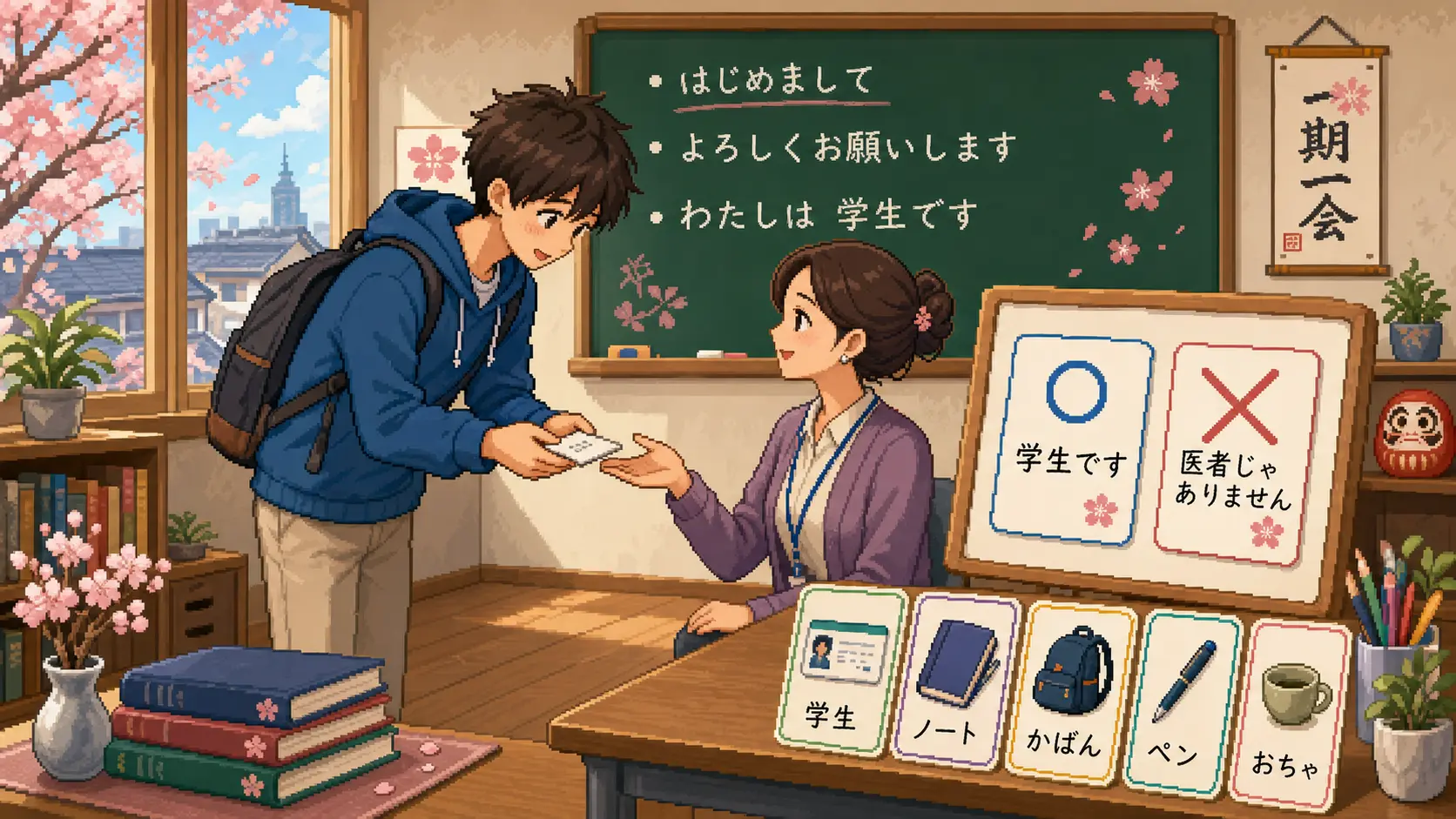
1. Affirmative: [Noun A] は [Noun B] です
To say “A is B,” you mark the topic (A) with は (wa) and end the sentence with です (desu).
means A is B (Polite Present Affirmative).
Formation
Noun A + は + Noun B + です
わたし は がくせい です。
Watashi wa gakusei desu.
I am a student.
たなかさん は せんせい です。
Tanaka-san wa sensei desu.
Mr. Tanaka is a teacher.
これ は わたしの ほんです。
Kore wa watashi no hon desu.
This is my book.
あした は にちようび です。
Ashita wa nichiyoubi desu.
Tomorrow is Sunday.
かのじょ は にほんじん です。
Kanojo wa Nihonjin desu.
She is Japanese.
きょう は あつい です。
Kyou wa atsui desu.
Today is hot.
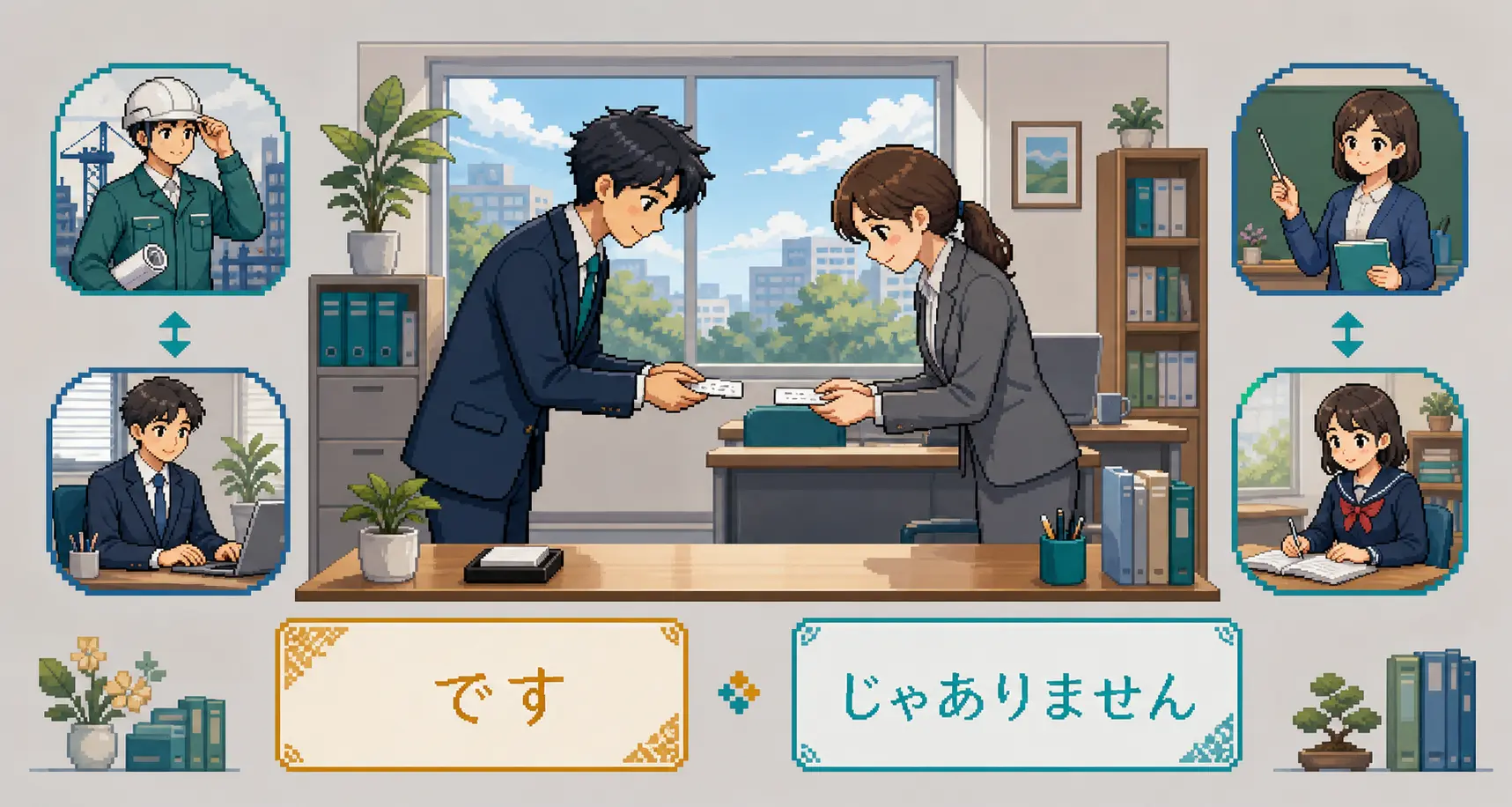
2. Negative: [Noun A] は [Noun B] じゃありません
To say “A is NOT B,” we change the ending to じゃありません (ja arimasen). This is the standard polite way to negate a noun.
means A is not B (Polite Present Negative).
Formation
Noun A + は + Noun B + じゃありません
わたし は いしゃ じゃありません。
Watashi wa isha ja arimasen.
I am not a doctor.
これ は ペン じゃありません。
Kore wa pen ja arimasen.
This is not a pen.
きょう は げつようび じゃありません。
Kyou wa getsuyoubi ja arimasen.
Today is not Monday.
[!NOTE] Politeness Levels:
- じゃありません (Ja arimasen): Standard polite (spoken).
- ではありません (Dewa arimasen): Formal/Written.
- じゃない (Ja nai): Casual (friends/family).
あのひと は がくせい じゃありません。
Ano hito wa gakusei ja arimasen.
That person is not a student.
にほんご は かんたん じゃありません。
Nihongo wa kantan ja arimasen.
Japanese is not easy.
それ は わたしの じゃありません。
Sore wa watashi no ja arimasen.
That is not mine.
3. Cultural Note: Jiko Shoukai (自己紹介)
A self-introduction is a crucial part of Japanese social life. Whether at school, work, or a party, there is a standard format:
- Hajimemashite: “Nice to meet you” (Literally: “It’s the first time”).
- [Name] desu: “I am [Name].”
- Yoroshiku onegaishimasu: “Please treat me well” (Literally: “I ask for your favor”).
The Bow (Ojigi): When doing Jiko Shoukai, it is common to bow slightly. Keep your back straight and bend from the hips. A 15-degree bow is standard for casual introductions, while a 30-degree bow is for business or superiors.
Conversation Practice
はじめまして。 たなか です。 よろしく おねがいします。
Hajimemashite. Tanaka desu. Yoroshiku onegaishimasu.
Nice to meet you. I am Tanaka. Please treat me well.
はじめまして。 スミス です。 こちらこそ よろしく おねがいします。
Hajimemashite. Sumisu desu. Kochirakoso yoroshiku onegaishimasu.
Nice to meet you. I am Smith. Likewise, please treat me well.
スミスさん は エンジニア です か。
Sumisu-san wa enjinia desu ka.
Are you an engineer, Mr. Smith?
いいえ、 エンジニア じゃありません。 かいしゃいん です。
Iie, enjinia ja arimasen. Kaishain desu.
No, I am not an engineer. I am a company employee.
あのひと は 先生 です か。
Ano hito wa sensei desu ka.
Is that person a teacher?
いいえ、 せんせい じゃありません。 がくせい です よ。
Iie, sensei ja arimasen. Gakusei desu yo.
No, they are not a teacher. They are a student.
そうですか。 あの ほん も 学生 の です か。
Sou desu ka. Ano hon mo gakusei no desu ka.
I see. Is that book also the student's?
はい、 そう です。
Hai, sou desu.
Yes, that's right.
Chapter Summary
- 1The copula 'desu' (です) links a topic to a noun (A is B).
- 2To make a sentence negative ('is not'), use 'ja arimasen' (じゃありません).
- 3Self-introductions start with 'Hajimemashite' and end with 'Yoroshiku onegaishimasu'.
- 4Bow slightly during introductions to show respect.
- 5Japanese word order stays the same for affirmative and negative; only the ending changes.
Knowledge Check
Test your understanding of the Japanese copula!
Which of these means 'I am a student'?
Practice Quiz
Which of these means 'I am a student'?
- わたし は がくせい です。
- わたし は がくせい じゃありません。
- わたし は せんせい です。
- あなた は がくせい です か。
What is the polite negative form of 'desu'?
- じゃありません
- です
- でした
- じゃありませんでした
How do you start a self-introduction (Jiko Shoukai)?
- Arigatou
- Hajimemashite
- Sumimasen
- Oyasumi
What does 'Yoroshiku onegaishimasu' mean in an introduction?
- I am sorry
- Thank you
- Please treat me well
- Goodbye
Translate: 'Tanaka-san wa sensei ja arimasen.'
- Mr. Tanaka is a teacher.
- Mr. Tanaka is a student.
- Mr. Tanaka is not a teacher.
- Is Mr. Tanaka a teacher?
Which particle marks the topic of the sentence?
- の
- を
- は
- が
What is the casual version of 'ja arimasen'?
- dewa arimasen
- ja nai
- desu
- deshita
Fill in the blank: 'Kyou wa nichiyoubi ____.' (Today IS Sunday).
- ja arimasen
- desu
- ka
- no
How do you say 'Are you Japanese?' politely?
- Anata wa Nihonjin desu.
- Anata wa Nihonjin ja arimasen.
- Anata wa Nihonjin desu ka.
- Hajimemashite.
Which bow is appropriate for a casual self-introduction?
- 15 degrees
- 30 degrees
- 45 degrees
- 90 degrees
Translate: 'I am not a doctor.'
- わたし は いしゃ です。
- わたし は いしゃ じゃありません。
- わたし は せんせい です。
- わたし は いしゃ じゃない。
What is the more formal/written version of 'ja arimasen'?
- desu
- ja nai
- dewa arimasen
- deshita
What does 'Kochirakoso' mean in a conversation?
- Excuse me
- Likewise / Same here
- Goodbye
- What?
True or False: In Japanese, the copula 'desu' changes based on the person (I am vs. You are).
- True
- False
Fill in the blank: 'Kore wa watashi ____ hon desu.' (This is MY book).
- は
- を
- の
- に
Applied review
Use what you learned
Focus: Copula and noun negation. Try the task before revealing the model.
Produce the Japanese sentence, then compare it with the model answer.
1.Say “I am not a doctor; I am a nurse.”
Copula and noun negation in context
N5 mini-reading
- Is Kimura a student?