Question Words & Particle か
Learning objectives
- Use the particle か (ka) to turn any statement into a question.
- Learn the 'Big Five' question words: Who, What, Where, When, and Why.
- Understand the difference between なに (nani) and なん (nan).
- Explore the cultural concept of 'Enryo' and how it affects social interaction.
In many languages, asking a question requires changing the entire word order. In Japanese, it is much simpler! To ask a question, you simply keep the sentence exactly as it is and add the particle か to the end. In this chapter, we will learn how to use this particle and master the essential words for seeking information.
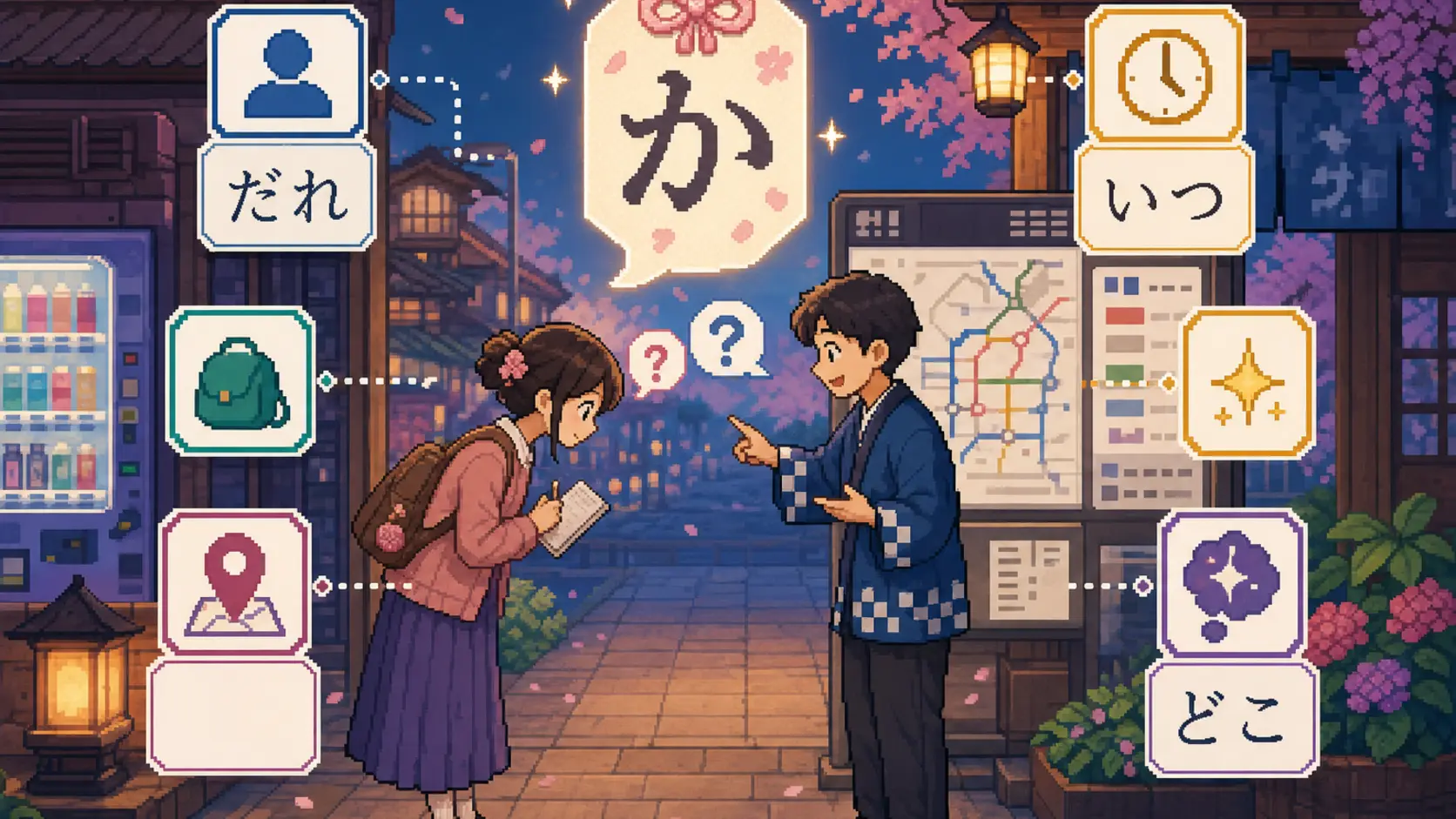
1. The Question Particle: か (ka)
The particle か (ka) acts like a spoken question mark. When you add it to the end of a sentence, it signals that you are asking for information.
means Turns a statement into a question.
Formation
Statement + か
これ は ぺん です か。
Kore wa pen desu ka.
Is this a pen?
あなた は 学生 です か。
Anata wa gakusei desu ka.
Are you a student?
コーヒー を のみます か。
Koohii o nomimasu ka.
Will you drink coffee?
2. The Big Five Question Words
To ask for specific information, you drop a question word into the slot where the answer would normally go.
なに / なん
Question Wordnani / nan
What
どこ
Question Worddoko
Where
だれ
Question Worddare
Who
いつ
Question Worditsu
When
どうして
Question Worddoushite
Why
[!TIP] なに vs. なん: Use なん (nan) if the next word starts with a D, T, or N sound (like desu). Use なに (nani) in most other cases.
それ は なん です か。
Sore wa nan desu ka.
What is that?
トイレ は どこ です か。
Toire wa doko desu ka.
Where is the toilet?
いつ 日本 へ いきます か。
Itsu Nihon e ikimasu ka.
When will you go to Japan?
3. Asking About People and Reasons
means Asking 'Who' and 'Why'.
Formation
Question Word + Particle + Verb + か
だれ が きました か。
Dare ga kimashita ka.
Who came?
どうして 日本語 を べんきょうします か。
Doushite Nihongo o benkyoushimasu ka.
Why do you study Japanese?
だれ の くるま です か。
Dare no kuruma desu ka.
Whose car is it?
4. Cultural Note: The Concept of ‘Enryo’ (遠慮)
Enryo is a vital Japanese cultural concept meaning “reserve,” “restraint,” or “modesty.” It involves holding back one’s own desires or questions for the sake of others or to maintain social harmony (Wa).
- When asked “Would you like some tea?”, a person might initially refuse due to enryo, even if they are thirsty.
- When asking questions, Japanese people often use “softening” phrases like Sumimasen (Excuse me) to show they are aware they might be bothering the other person.
- Understanding enryo helps you realize that “No” might sometimes mean “I’m being polite,” and “Yes” might sometimes be a bit hesitant!
Practical Conversations
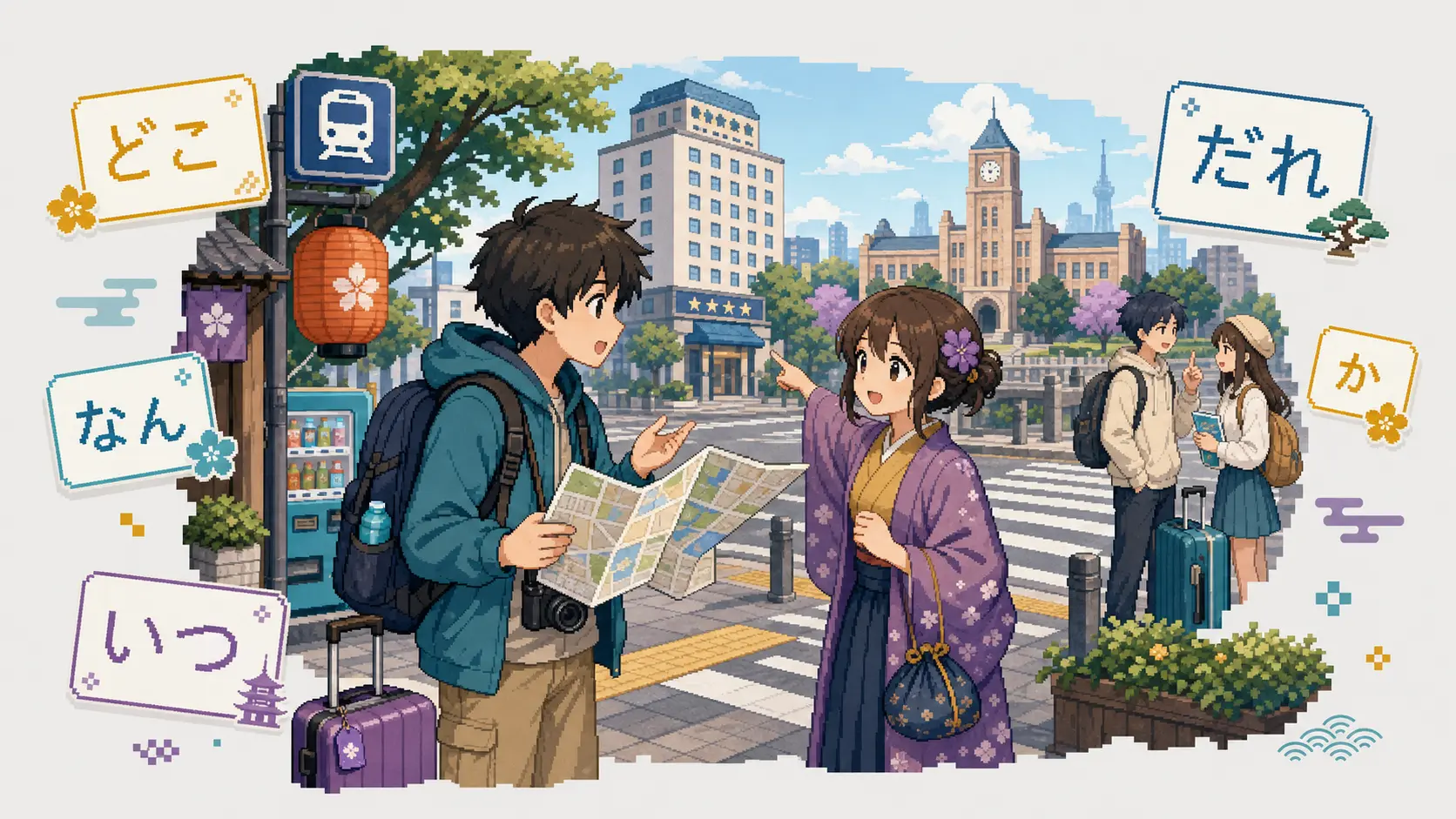
すみません、 ホテル は どこ です か。
Sumimasen, hoteru wa doko desu ka.
Excuse me, where is the hotel?
あ! あそこ です。
A! Asoko desu.
Ah! It's over there.
ありがとうございます。 これ は なん です か。
Arigatou gozaimasu. Kore wa nan desu ka.
Thank you very much. What is this (building)?
これ は だいがく です。
Kore wa daigaku desu.
This is a university.
アンナさん、 いつ 日本 へ いきます か。
Anna-san, itsu Nihon e ikimasu ka.
Anna, when will you go to Japan?
らいげつ いきます。
Raigetsu ikimasu.
I will go next month.
だれ と いきます か。
Dare to ikimasu ka.
Who are you going with?
かぞく と いきます。
Kazoku to ikimasu.
I am going with my family.
Chapter Summary
- 1The particle か (ka) at the end of a sentence creates a question.
- 2Japanese word order stays the same in questions; just replace the missing info with a question word.
- 3Question words include なに (What), どこ (Where), だれ (Who), and いつ (When).
- 4Use なん (nan) before D, T, or N sounds, and なに (nani) otherwise.
- 5Enryo (遠慮) is the social practice of being reserved and mindful of others when interacting.
Knowledge Check
Test your ability to ask and understand questions!
Which particle turns a statement into a question?
Practice Quiz
Which particle turns a statement into a question?
- は
- の
- か
- を
How do you say 'Where'?
- なに
- どこ
- だれ
- いつ
Which pronunciation of 'What' is used in '_____ です か'?
- なに
- なん
- ぬに
- のん
What does 'だれ' mean?
- What
- Where
- Who
- When
Translate: 'いつ いきます か。'
- Where are you going?
- When will you go?
- Who is going?
- Why are you going?
What is 'Enryo'?
- A type of Japanese food
- The concept of social reserve or restraint
- A formal way to say goodbye
- A particle for emphasis
How do you ask 'Whose book is this?'
- これ は だれ の 本 です か
- これ は だれ 本 です か
- これ は なに の 本 です か
- だれ は これ 本 です か
Which question word is used for 'Why'?
- いつ
- どうして
- どこ
- だれ
When should you use 'なに' (nani) instead of 'なん' (nan)?
- Before 'desu'
- Before the particle 'o' (を)
- Before the particle 'no' (の)
- Never
Translate: 'トイレ は どこ です か。'
- What is a toilet?
- Is there a toilet?
- Where is the toilet?
- Who is in the toilet?
True or False: Japanese word order changes completely for questions.
- True
- False
If someone asks you 'Doushite Nihon e ikimasu ka', they want to know:
- When you are going
- Who you are going with
- Why you are going
- Where you are going
How do you ask 'Which one?' when choosing from several items?
- なに
- どれ
- だれ
- いつ
Translate: 'だれ が きました か。'
- Who came?
- Where did you go?
- What did you do?
- When will you come?
In the conversation 'Ocha o nomimasu ka', what does 'Ocha' mean?
- Water
- Coffee
- Tea
- Juice
Applied review
Use what you learned
Focus: Questions with か. Try the task before revealing the model.
Produce the Japanese sentence, then compare it with the model answer.
1.Politely ask where the station is.
Questions with か in context
N5 mini-reading
- Whose umbrella is it?